Wednesday, 2 June 2010

A thank you to Minister George Papaconstantinou


I owe a debt of thanks to the staff of the Ministry of Finance, who assisted in the issue of our corporate tax residency certificate, which was finally issued on Friday, 28 May and was available on Monday, 31 May.

On Tuesday, May 25th, I wrote an email to Minister of Finance George Papaconstantinou, explaining the situation. On Thursday, May 27th, I received a telephone call from the Ministry, asking for clarifications, and promising to clear up the matter. This was duly accomplished.

On Friday, May 28th, I received a telephone call from the Ministry that the tax certificate was ready, and that I could pick it up on Monday, May 31st.

This entire process started on March 17th, and was completed on May 31st. More than anything else, it has challenged my fundamental belief in Greece and its system of economic administration. I have rarely seen so much inefficiency, so many useless processes, and so much public sector hostility for what should be a routine form.

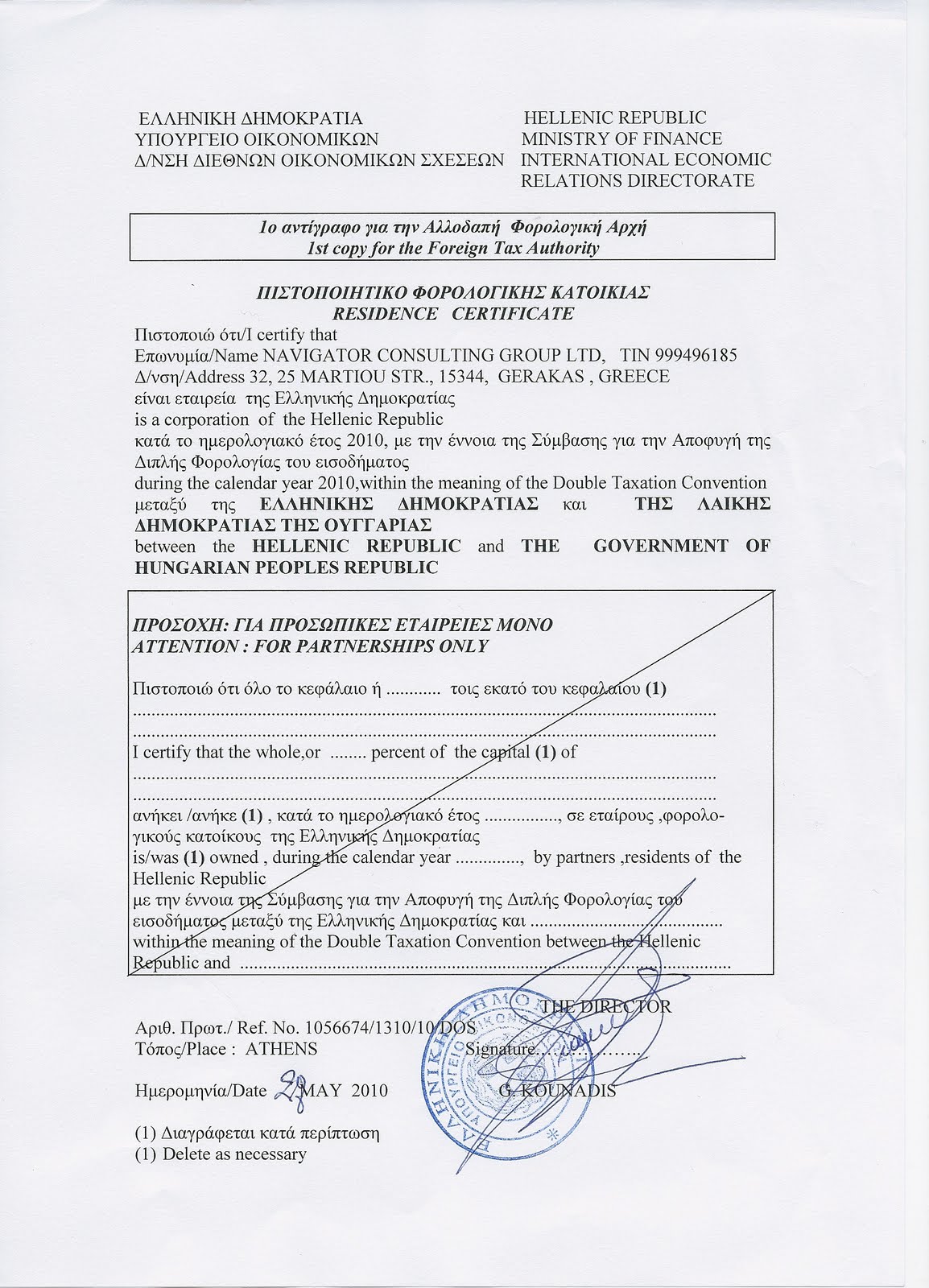
As you can see from one of the certificates (pictured above), the text is entirely simple and indeed innocuous:

I certify that Navigator Consulting Group Ltd, TIN 999496185, registered at 32, 25 March Street, Geraka 15344 Greece, is a corporation of the Hellenic Republic during the calendar year 2010, within the meaning of the double tax convention between the Hellenic Republic and the government of the Hungarian Peoples' Republic."

The Ministry, and its political leadership, are trying to implement an extremely difficult programme, and it’s clear that one of the main barriers is the creaking, inefficient structure of the public administration and its internal processes.

The new government has recently launched some new measures for e-government, pertaining to the payment of automotive circulation taxes and similar measures. I sincerely hope they will be able to stabilise the financial situation of Greece, and implement e-government (especially if they put this tax residency certificate online). Indeed, success is the only option available.

So, to Minister Papaconstantinou and the staff at the Ministry: Thank you for responding to my email, and looking into the matter. And good luck.


Tuesday, 1 June 2010

Greece’s Corruption Non-Scandal

I don’t know if it’s a political tactic, or renewed zeal on the part of Greece’s unelected and unaccountable journalists, but the past month has seen a steady escalation of discoveries of government corruption and dramatic tales of inefficient practice.

·        On Sunday, Kathimerini broke the story that former Defence Minister Akis Tsochatzopoulos’ wife purchased a house on Dionissiou Areopagitou Street for EUR 1.1 mln from a series of two offshore companies, one of which was implicated in the Vatopedi land exchange scandal. The actual value of the house is obviously far higher.

·        Last week, former transport minister Tasos Mantelis admitted to the Parliamentary committee investigating the Siemens bribery scandal that he received DM 200,000 in “pre-election campaigns” from Siemens. This cast the political class into an uproar.

·        Last night, Ioannis Pretenteris reported that the Olympic Village, an organisation set up to manage the 2004 Olympic Games athlete’s village, increased its staff to over 150 full-time staff in the past 4 years, well after the games had ended and most or all of the buildings had been sold or transferred. Among the professions hired included graphic designers, communications experts and psychologists (useful for elections, but not for managing a real estate company without assets). The total wage bill amounted to about EUR 23 million.

·        Makis Triantafyllopoulos reported that based on a comparative analysis of medicine costs, the Hellenic national insurance fund (IKA) is paying significantly more for the same medical disposables (e.g. cotton gauze) than equivalent national health organizations in Italy, France or the UK. In some cases, the difference is over 200-300%.

Although I am very much in favour of public disclosure, I have concluded that none of this steady drip-drip-drip of “scandals” is going to result in a lasting solution. Why?

a.      The only reason that Siemens is an issue is because the German prosecutor’s office has done the investigative work. Greece has taken practically no steps to launch a fully independent, forensic investigation of public procurement and political finance, and does not have such an organisation capable of doing so.

b.     The published amounts of Siemens—loosely stated at about EUR 100 mln in bribes disbursed over a 17 year period—are nearly the same amount as the bribes distributed by the Howaldtswerke-Deutsche Werft (HDW) and its subsequent owners for the construction of four submarines at Skaramangas. This case has also been published by the German prosecutor’s office, but is not being investigated by anyone in Greece. Why the difference?

c.      Siemens is one of two main organisations which provided telecommunications equipment to OTE and other government organisations over the past 20 years. There is another company, Intracom which in the past has featured prominently in corruption allegations. The owner of Intracom, Socrates Kokkalis, is also owner of Intralot, which has gained major contracts with the OPAP betting organisation. Is Intracom the subject of a Parliamentary inquiry?

d.     The amounts procured by the government for weapons contracts and other major capital works (e.g. Athens International Airport, the Attiki Odos, etc.) amount of at least EUR 5-7 bln per year. If we assume a similar system of kickbacks and commissions as what has been already reported in the press, then it’s clear that a DM 200,000 “campaign contribution” from Siemens is an insignificant amount. What is being done to investigate actual contracts, as opposed to individual companies or individual politicians?

e.      One of the main “havens” of dirty money is Cyprus, where there are at least 3,000 offshore companies registered by Greek interests. Many of these companies are shielded behind nominee shareholders, making the identity of the true owners difficult to reveal. What steps are being taken to investigate the ownership of bank accounts in Cyprus, especially given that Laiki-Marfin and Bank of Cyprus have such a large banking network in Greece?

For various reasons, I believe that what we are seeing today is nothing more than a “bread and circus” approach to political corruption. Unless a serious effort is undertaken to use forensic accounting methods, there will be little opportunity to uncover the truth, or recover the stolen money.

Greece has a number of options for this:

1.     It can nominate an independent forensic auditor, such as Debevois and Plimpton, which handled the Siemens investigation, to open a full-scale, independent inquiry. (It’s clear that neither the Hellenic Parliament, nor the PASOK Ethics Committee, to which Mr. Tsochatzopoulos was referred this week, have the capacity to undertake such an investigation, even if they had the political will).

2.     It can require Marfin-Laiki, Bank of Cyprus and other Cypriot banks to provide a list of Greek owners of offshore banking accounts in Cyprus, or face a suspension of their banking licenses in Greece. (This is the same tactic that the US Government has taken in Switzerland with success. However, since so many Greek politicians and their family members appear to have offshore bank accounts, this will probably never happen).

3.     It can appoint a third-party purchasing organisation, such as Crown Agents or SGS, to take over and maintain a transparent, central purchasing organisation for medical equipment and disposables as well as other sectors.

4.     It can request that the US Federal Bureau of Investigation or the US Secret Service set up an independent financial crimes investigative unit, staffed by a Greek expatriate or other newcomer to the Greek scene, for a minimum period of 10 years, with a ring-fenced, full budget and full authority to investigate political corruption.

5.     It can lift the outmoded and corrupting system of Parliamentary immunity and the statute of limitations on certain categories of crimes.

6.     It can demand that the Republic of Cyprus end the practice of nominee shareholding, at least for Greek citizens, or companies receiving funds from Greece.

Obviously, none of this is going to happen. We will be fed a steady stream of serious or not-so-serious disclosures, and perhaps some people will be imprisoned for minor misdemeanors.

It is exceptionally difficult to understand how these serious crimes will be investigated, since their very instigators are often still in Parliament, or represented in Parliament by their descendents and relatives. Alternatively, they are still in the civil service, and in many cases their entire family works there. Alternatively, they are still political party members in good standing.

In the present case, despite whatever good intentions there are (and I welcome them), I don’t believe the same political architects which created this corrupt system have the wherewithal to reform it. Everything we are seeing to date is an effort at damage control, using the full array of meaningless slogans or false outrage such as “μην μας απαξιώνεται” or “μην μας ισοπεδώνεται”.

Christos Papoutsis’ outburst on “Anatropes” last night is an excellent case of this: every other politician I’ve seen on Kardavellas or Triantafyllopoulos or the news in the past 8 days has reacted exactly the same way. Condemn the general situation; deny any personal responsibility; refuse to offer any real solutions or straight answers.

Welcome to the desert of the real.

Thursday, 27 May 2010

Latest Developments in the Phantom Tax Residency Certificate

Earlier this morning I received a telephone call from the Ministry of Finance in response to an email I sent on Tuesday.

After explaining the situation, I was put in touch with the director of the International Economic Relations. She started out by asking me how it was possible that my company, which is named “Navigator Consulting Group Ltd.” and is registered in Greece, can have the same name as another company named Navigator Consulting Group”, which is registered in Long Island, New York.

I spent 3 minutes explaining to her the fact that every country has its own corporate registry, and that for my company to register a corporate brand name in 260 countries and territories in the world was prohibitively expensive. She asked me, in an indignant tone “Does this mean that if someone else registers the name “OTE” in America they are allowed to?” I responded that yes, they were, insofar as OTE Greece had not registered its name first, that there were no other “OTEs” registered, and that this name did not conflict with the established laws of the United States.

I was then informed that because this was so suspicious, she had to request a clarification from the US Internal Revenue Service to confirm that there were no links between Navigator Consulting Group USA and Navigator Consulting Group Greece.

I asked how long this would take. She could not answer me.

I pointed out that I had, at her request, faxed her our Articles of Association (Καταστατικό), which clearly shows who the owners of Navigator Consulting Group Greece are, and that in fact our legal Greek name is Συμβουλευτικός Όμιλος Ναβιγκειτορ ΕΠΕ. This apparently did not count.

I asked her why this process had to be followed, if last year (2009 financial year), the Ministry of Finance already gave me a Tax Residency Certificate in a much shorter time frame, for my same company. There was no answer to this question.

I finally asked her why this process should be followed, since I was already declaring the income in Greece from my international contracts. The application form of the Ministry asks for the amount, the client paying the amount, etc. In addition, I included formal copies of our signed contracts. There was no answer to this question either.

My objective conclusions are that

a. The people working in the International Economic Relations Department have little understanding of basic aspects of international business, such as the registration of corporate names, trademarks or brands;

b. The contradictions inherent in the administrative process are so many that there is absolutely no logic or value to it.

This process serves neither the objective requirements of the Greek state, nor my requirements as a business person. As a result, I am closing the company here as fast as I can, and transferring our work to London.

There is absolutely no hope in this country, no hope at all.

Monday, 24 May 2010

Greece's Million Euro Website

www.parliament.gr and www.hellenicparliament.gr

In response to a question posed in Parliament by LAOS deputy Kyriakos Velopoulos, Filippos Petsalnikos, the President of the Parliament, confirmed the following:

· The development of the website was financed under the Third Community Support Framework “Information Society”, and was approved under the Parliamentary presidency of MP Benaki-Psarouda and completed under the presidency of MP Sioufas.

· The total cost of the website’s development was EUR 1,011,318.89.

· There was an additional cost for “staff training and management” of EUR 48,197.39

The total costs were EUR 1,059,516.27, including VAT, of which 80% was financed by the European Union. You can see the written correspondence at the end of this post.

This latest example of egregious waste received limited coverage from mainstream press, but extensive coverage on the Greek blogosphere.

I have rarely been angrier in my life than when I first read about this in Kathimerini. The costs of the present platform are certainly not more than EUR 10,000 – 15,000 in today’s costs. Even assuming a higher price for a portal set up 4-5 years ago, the costs should not exceed EUR 20,000 – 25,000.

More than anything, this confirms my decision to wind down my company in Greece. I refuse to pay for any more of this.

Letter from LAOS MP Kyriakos Velopoulos


Response from Parliament President Filippos Petsalnikos


Saturday, 22 May 2010

The Missing Tax Certificate ... and the end of the affair

Since March 17th, I have been trying to obtain a Certificate of Tax Residency from the Hellenic Ministry of Finance.

This certificate is a government document which confirms the tax residency of my company, Navigator Consulting Group Ltd. in Greece. It’s something we get nearly every year – you can see a copy of our 2009 certificate below. It should be a formality, but in fact is an extremely time-consuming process ridden by bureaucratic inefficiency and gross stupidity that is emblematic of doing business in Greece.

The procedure for obtaining this certificate is the following: We submit a first application to our Regional Tax Office, the DOY Pallinis, requesting a formal certificate that we are registered in the Pallini tax region. With this in hand, we have to go to the Ministry of Finance, to request a second, formal Tax Residency Certificate, which for some reason can only be granted by the Ministry of Finance.

To our vast surprise, the Pallini tax office refused to give the certificate. The reason for this was that we had not yet filed a tax return in Pallini. This is true. Our tax filing deadline was May 15th.

Prior to this, we were registered in the Halandri Tax Authority. We moved our corporate address from Halandri to Geraka (which is part of the Pallini tax region) in October 2009. This involved a legal change in our corporate statutes, authorised by a public notary, and includes publication in the Government Gazette.

I therefore have to ask what the point is of doing an official change of address, which is published in the Government Gazette, at a total cost of nearly EUR 1,000 and over 1 month of processing time if the tax office to which we have moved refuses to recognise us.

This is even more stupid, when you consider that anyone can look up our tax number on the Ministry of Finance’s online TAXIS system, and see that we are registered at the Pallini Tax Office.

So we are legally registered at the Pallini Tax Office. But the Pallini Tax office does not recognise us.

Our accountant had to make 6 different trips between DOY Halandriou and DOY Pallinis, finally brokering a compromise whereby the Halandri tax office wrote a “Departmental Note” (Υπηρεσιακό Σημείωμα), which our accountant took back to the DOY Pallinis, finally getting them to issue the first certificate. This process took over 1.5 months: the certificate was submitted to the Ministry of Finance on May 3rd.

The Ministry of Finance normally needs 10 working days to process this form into a second form, the official Certificate of Residence. As of yesterday, 21 May, the Certificate was not ready.

Why do I need this certificate in the first place? On March 22nd, I started a due diligence and business planning project for a leading CIS company, which required a Tax Residency Certificate to advance a 50% project downpayment. I also need it to invoice the final billings for three other projects.

So, at a time when the Greek government is bankrupt, I am not only importing consulting fees (by export consulting services) from abroad, but I am doing it legally: by declaring the income. Instead of helping me, the Greek tax system is causing an unacceptable delay, and a serious cash flow problem for my firm.

After this experience, I have decided to close our company in Greece, and bill all new work through our new company in London. I can no longer afford to have both my professional reputation as a Greek service provider dragged through the mud by the machinations of an irresponsible government, and then face these unacceptable delays in what should be a simple tax certificate.

I am also no longer willing to pay multiple, absurd fees for the Government Gazette or the tax office or whomever, if the very system does not respect its own rules. And this is not to speak of million Euro websites for the Greek Parliament, or Siemens bribes, or Vatopedi, or German submarines.

The fact is that no one in a position of political responsibility in this country appears to have any idea of the challenges faced by individuals or companies to implement what should be a simple business procedure. While the Prime Minister jets off to meetings of the Socialist International, I am struggling to pay bills, because I can’t obtain a simple tax residency certificate, even though we have abided by all the rules, and are 100% legal.

We have operating our consulting firm in Greece since 1995. In this time, we have been one of the few Greek consultancies working in “real-world” (as opposed to subsidised) investment management and due diligence in international markets, having advised manufacturers and international financial institutions on over 40 projects and EUR 3 billion in invested resources. This era is now coming to an end, as we move our consultancy to a location which actually supports small business.

Perhaps this story will help our elected officials reflect on why Greece scores so badly in international business environment rankings. Like most actual, everyday experience, however, I am sure it will be ignored, in favour of complex political theory and empty rhetoric which has nothing at all to do with reality.

Wednesday, 12 May 2010

The EUR 83 mln Greek Submarine Mystery

Skaramangas Banner at the May 5th Demonstrations in Athens

One of the great, unspoken mysteries surrounding corruption scandals in Greece today is that of the EUR 83 million bribe allegedly paid by the Howaldtswerke-Deutsche Werft (HDW) signed an agreement with the Greek government for the construction of 4 submarines at Skaramanga in 2002.

Since April 2010, Kathimerini has been running a series of articles in which it claims that, according to sources at the prosecutor’s office in Munich, the total amount paid by HDW (later purchased by Ferrostaal, a division of ThyssenKrupp) was EUR 83 million for the four submarines.

This investigation has been widely reported in Germany, not least by Der Spiegel and other sources. But no official conclusions or legal actions have been filed yet.

The Greek government has until recently refused to take delivery of the four submarines, since the first one, the Papanikolaou, listed heavily during sea trials. The incoming Prime Minister, George Papandreou, recently reversed this decision, and has agreed not only to pay the EUR 1.8 bln for the previous four submarines, but even to order two more submarines from ThyssenKrupp at a cost of a further EUR 1 bln.

In a further bizarre twist, the Skaramangas shipyards were recently sold by ThyssenKrupp to Abu Dhabi Mar. Kerin Hope of the Financial Times reports, incredibly enough, that

Nikos Papandreou, the prime minister’s brother, was called in to help with the Abu Dhabi deal because of “the urgency of the situation”, according to defence ministry officials.

I’m extremely reassured to know that the Prime Minister can call upon his brother’s services so freely, circumventing the entire Ministries of Defence, Finance and Economics, or even the Ministry of Foreign Affairs, for urgent situations of this type.

I am doubly reassured by the fact that the Greek taxpayer will probably soon be called to return EUR 230 mln in state aid to Skaramanga, if the European Court decides against Greece (as I somehow suspect it will).

For obvious reasons, I can’t state many conclusions here, since there is still no legal evidence of anything improper. But I believe that anyone reading the articles indexed below can draw their own conclusions without my assistance.

The banner photographed by Stratos Safioleas during the Wednesday May 5th demonstrations in Athens express my sentiments fully. Thanks to him for letting me reproduce it.

Submarine cash revealed

http://www.ekathimerini.com/4dcgi/_w_articles_politics_0_12/04/2010_116293

Move to settle submarine spat

http://www.ft.com/cms/s/0/615e4cf0-33a3-11df-9223-00144feabdc0.html

Προμήθεια 83 εκατ. για την παραγγελία των υποβρυχίων

http://news.kathimerini.gr/4dcgi/_w_articles_ell_2_11/04/2010_397161

How German Companies Bribed Their Way to Greek Deals

http://www.spiegel.de/international/europe/0,1518,693973,00.html

Germany's Ferrostaal Suspected of Organizing Bribes for Other Firms

http://www.spiegel.de/international/business/0,1518,686513,00.html

Σκαραμαγκάς: οι νέοι ιδιοκτήτες, τα υποβρύχια και οι προμήθειες

http://news.kathimerini.gr/4dcgi/_w_articles_economyepix_2_07/03/2010_393285

Οι Αραβες, τα υποβρύχια και η «προίκα» του Σκαραμαγκά

http://news.kathimerini.gr/4dcgi/_w_articles_economyepix_2_07/03/2010_393306

Τα υποβρύχια βουλιάζουν τον Σκαραμαγκά...

http://www.mediashipping.gr/?q=node/4182

Παραπομπή της Ελλάδας στο Ευρωπαϊκό Δικαστήριο για ενισχύσεις προς Σκαραμαγκά

http://news.kathimerini.gr/4dcgi/_w_articles_economy_2_15/04/2010_397502