Monday, 23 March 2015

Impacts of Grexit


Many analysts and commentators have been discussing the potential of a Greek exit from the Eurozone, or “Grexit”. This is a very complex subject which cannot easily be assessed without a detailed econometric assessment of Greece’s economy and a wider assessment of Greece’s polity and society. What is possible is to explore some major themes and issues of a Grexit, and examine some relative impacts these may have on Greece’s economy and society. As there are a large number of variables involved, what follows is more of a concept note than a specific forecast.

This article was originally written on 12 February 2015 and first appeared on the Navigator website. 

Issue 1: Grexit within the Euro

Contrary to popular understanding, a “Grexit” does not necessarily mean a new currency will be introduced. The key monetary requirements for participation in the Euro are in fact contained in the Maastricht criteria of the Maastricht Treaty. It should be clear from an examination of these criteria that Greece has been in violation of the Treaty since it joined the Euro, yet it has continued to use the Euro currency.

One definite alternative is that Greece will unilaterally default but remain within the Eurozone. What does this mean?

·       Greek banks and the Greek government would be barred from using European Central Bank refinancing in all but the narrowest of transactions (this is now already the case).

·       Other Eurozone countries no longer accept Target 2 transfers, or specifically, liabilities, involving Greek transactions. There is no precedent for this, and it is uncertain how this would work in practice.

·       Any other Eurozone public sector financing of Greece stops. This might include a cancellation of disbursements of European structural and cohesion funds. 

·       Greece’s credit rating would of course fall to unprecedented lows, and any form of foreign investment or lending would be eliminated.

In this case, the practical impact for Greece businesses and citizens will be that:

·       The Greek banking system will effectively have to be either nationalised, liquidated and merged, depending on the severity of the problem. The Greek state currently controls the majority of shares in three of the four systemic banks and would be within its rights to take drastic action.

·       The Greek banking system will quickly implement capital controls, preventing deposit flight and outbound transfers.

·       The Greek government will begin honouring its commitments (salaries, pensions, etc) using a mix of cash and promissory notes or Greek government bonds.

·       A barter economy will quickly grow, replacing cash transactions.

·       A black market for cash leaving or entering the country will quickly emerge.

·       Official economic activity will fall dramatically.

Many economists will no doubt respond that this idea is preposterous: that the idea of Grexit is to leave the Eurozone, develop a new central bank and currency, and allow that currency to devalue as a means of regaining competitiveness and control of the economy.

But this is not so simple, and any move in this direction will almost certainly include some of the preliminary stages discussed previously. Why?

·       Because the majority of the Greek population does not want to leave the Euro. Doing so carries an important political risk for the ruling party that proposes such a move.

·       Because even if Greece has a new currency, as long as it is in the European Union it is bound by the “Four Freedoms”, or free movement of people, goods, capital, and services. As long as this is the case, Greece cannot unilaterally levy the tariff and credit barriers which are a necessary complement for a currency devaluation to function. It will still be part of a common trade area in the EU (and by extension China and other non-EU countries), and will still have grievous competitive disadvantages in the real economy.

·       Because even a Grexit does not mean that the national debt is eliminated (see next section, below).

Issue 2: Grexit outside the Euro

Grexit, as usually implied in the press, necessitates Greece developing a new currency (the “NewDrachma”), managed by the Greek Central Bank. Many analysts, including Paul Krugman, imply that Grexit is manageable, and that the current costs of the Greek bail-out are equivalent to the economic damage expected from Grexit anyway.

But this scenario is also flawed. It ignores—or assumes—that simply by exiting the Euro, Greece’s public debt will disappear. It will not.

Nearly 80% of Greece’s € 322 billion public debt is in the hands of official creditors. There is no reason to assume that:

a.     This debt will be forgiven following Grexit, and/or
b.     This debt will automatically be re-denominated in New Drachmae.

It is sloppy intellectual reasoning to imply that either of these two conditions will materialise as a fait accompli of a Grexit.  

The damage of Grexit under the current circumstances is the worse of all worlds. It would require a rapid deflation of the New Drachma against other hard currencies, while making the public debt impossible to service. In fact, this scenario is exactly what happened to Germany in 1919 at the end of World War II, when it was forced to pay reparations in gold or foreign currencies.

The result of Germany’s experience is in the historical record: hyperinflation, poverty, and the rise of extremism which lead to Adolph Hitler’s takeover of the Reichstag through a mix of legal and extra-legal means.

As a result, a classical economics analysis of Grexit would assume the following:

a.     Immediate devaluation of the New Drachma by 40-60% against the Euro and US Dollar. Greek GDP would automatically fall by the same percentage in hard currency terms, creating a renewed cycle of uncertainty.

b.     All important trade and other contracts would remain formally or informally pegged to the Euro or US Dollar Libor or Eurobor rate, creating an incredible pressure on the New Drachma. This has been seen in Russia following the 1998 devaluation, and even in Greece prior to Euro entry.

c.     Imported products, including most consumer goods, automobiles, oil and gas, and many foodstuffs and stables, would automatically become 40-60% more expensive.

d.     Inflation will begin rising to 15-18% per year in the best case scenario in the 2-3 years following the new currency.

e.     Greek exports and service exports (tourism) would become more competitive. However, they would be deprived of working capital necessary to finance imports, exports, or the 3-6 month credit term demanded by most tour operators for Greek hotel rooms. As a result, Greek enterprises will not be able to take advantage of the declining currency, at least not in the short term.

f.      Greek services and products sold in the domestic market would become more competitive, assuming that the large majority of their inputs are sourced in Greece. For instance, Greek potato chips made from Greek potatoes would be more price competitive that Greek potato chips made from Polish potatoes (depending on the cost of energy, transport and packaging).

g.     Inflation and uncertainty will lead to an immediate fall in consumer spending and investment, at least over the short term.

h.     Greek banks would likely be forced to convert their Euro-denominated loans to New-Drachma-denominated loans, at the starting price of the New Drachma. As the New Drachma devalues, however, the headline cost of the loan would increase either in or out of proportion with the devaluation and/or inflation. So either the banks will go bankrupt through loan write-downs (and borrowers will benefit), or borrowers will be strangled by an ever-appreciating cost of their loan. Whatever the case, new credit issues from Greek financial institutions will be eliminated.

i.       Strict credit and transfer limits will be introduced. Cash withdrawals from banks will be limited. International outbound transfers will be limited. Incoming transfers or cash exchanges will be automatically converted at the low, “official” rate. There will be a growing gap between the official and unofficial exchange rates for the New Drachma.

j.       A lucky few and the politically-favoured will enjoy access to scarce credit. Everyone else, including healthy enterprises and families, will suffer. We have seen this scenario before in Greece, notably with who got loans from “private” banks or state-backed banks such as ETBA.

k.     It must be emphasised that even with a devalued New Drachma, Greece remains part of the Eurozone. As a result, we can expect fire sale prices of vacation homes, agricultural land, companies and all kinds of other assets, as European investors descend on Greece eager to take advantage of their strong currency, and as Greek owners desperately sell at any price. Much of the transactions will be done offshore or “under the table”, enabling the Greek seller to avoid tax and keep hard currency income.

l.       Black market activities will increase. Labour migration outside of Greece will increase. Barter activity will increase. Formal economic activity will fall still further.

It is difficult to forecast how long the adjustment shock would last, but I believe that 2-4 years will be necessary before the economy begins to grow and function again at anything approaching a normal trend rate.

In time, assuming stable political developments, one could imagine Greece returning to the economic system it enjoyed in the late 1980s: a continually-devaluing national currency; high inflation; very limited credit; rampant demagoguery and corruption in the political class. The last point has arguable not changed much since then.  

But now we need to ask what happens not from a classical economics viewpoint, but from the social and political viewpoint. This is perhaps best done by posing a series of questions that are rarely heard.

a.     Why should we assume that Greece will remain stable?

b.     How long will Greece remain a democracy given the relatively calm scenario discussed above? How long will it remain a democracy given the presence of political parties which have relied upon extra-legal tactics in the past?

c.     Who will be the next “man on a horse” (one of many in Greek history) to “save Greece?”

d.     Can Greece survive in the European Union even if it exits the Eurozone? Can it survive a devalued currency given its free market agreement and inability to set protective tariffs? 

e.     Will other European partners tolerate continued Greek involvement in European decision-making and support programmes given the magnitude of the implied default? Or will other European societies turn against Greece, and against the Greek diaspora communities living in their midst?

f.      Can Greece continue to defend its national borders against an irredentist neighbour when it will be unable to buy fuel, spare parts or ordnance for its military, or when its European partners will be manifestly unwilling to get involved in any further Greek adventures?

g.     Viewing the constant scenes of poverty and tension in Greece, what happens to foreign tourism arrivals in the immediate aftermath of a devaluation? Do we really assume that tourism and normal economic flows will remain unaffected? 

h.     What will popular reaction be when the population views “locust investors” asset-stripping Greece at low prices, or hears yet more tales of starving schoolchildren?

As stated previously:

·       There is no point in Grexit without a simultaneous exit from the European Union, allowing Greece to fully set its own tariff and credit policies.

·       An exit from the Euro neither cancels nor re-denominates Greece’s sovereign debts.

·       Given Greece’s failure to manage its economy and public sector properly over 30 years of prosperity, we should be under no illusions that it will do any better in the economic depression and crisis that would follow a Grexit.


(c) Philip Ammerman, 2015 


Thursday, 19 February 2015

SYRIZA backs down - confirms intent to negotiate within the Bailout Memorandum

After nearly four weeks of incoherent and often irresponsible electioneering-style rhetoric, the SYRIZA government has accepted to negotiate within the original bailout memorandum. This opens the way for what everyone hopes will be constructive negotiations from both sides. Many of SYRIZA's intended policy changes are eminently rational and should be given a fair hearing, providing they can justify the ways and means.

The English language text was reported on To Vima and Skai just now.

"Athens, February 18, 2015

Dear President of the Eurogroup,


Over the last five years, the people of Greece have exerted remarkable efforts in economic adjustment. The new government is committed to a broader and deeper reform process aimed at durably improving growth and employment prospects, achieving debt sustainability and financial stability, enhancing social fairness and mitigating the significant social cost of the ongoing crisis.

The Greek authorities recognise that the procedures agreed by the previous governments were interrupted by the recent presidential and general elections and that, as a result, several of the technical arrangements have been invalidated. The Greek authorities honour Greece's financial obligations to all its creditors as well as state our intention to cooperate with our partners in order to avert technical impediments in the context of the Master Facility Agreement which we recognise as binding vis-a-vis its financial and procedural content.

In this context, the Greek authorities are now applying for the extension of the Master Financial Assistance Facility Agreement for a period of six months from its termination during which period we shall proceed jointly, and making best use of given flexibility in the current arrangement, toward its successful conclusion and review on the basis of the proposals of, on the one hand, the Greek government and, on the other, the institutions.

The purpose of the requested six-month extension of the Agreement's duration is:


(a) To agree the mutually acceptable financial and administrative terms the implementation of which, in collaboration with the institutions, will stabilise Greece's fiscal position, attain appropriate primary fiscal surpluses, guarantee debt stability and assist in the attainment of fiscal targets for 2015 that take into account the present economic situation.


(b) To ensure, working closely with our European and international partners, that any new measures be fully funded while refraining from unilateral action that would undermine the fiscal targets, economic recovery and financial stability.

(c) To allow the European Central Bank to re-introduce the waiver in accordance with its procedures and regulations.


(d) To extend the availability of the EFSF bonds held by the HFSF for the duration of the Agreement.


(e) To commence work between the technical teams on a possible new Contract for Recovery and Growth that the Greek authorities envisage between Greece, Europe and the International Monetary Fund which could follow the current Agreement.


(f) To agree on supervision under the EU and ECB framework and, in the same spirit, with the International Monetary Fund for the duration of the extended Agreement.


(G) To discuss means of enacting the November 2012 Eurogroup decision regarding possible further debt measures and assistance for implementation after the completion of the extended Agreement and as part of the follow-up Contract.


With the above in mind, the Greek government expresses its determination to cooperate closely with the European Union's institutions and with the International Monetary Fund in order: (a) to attain fiscal and financial stability and (b) to enable the Greek government to introduce the substantive, far-reaching reforms that are needed to restore the living standards of millions of Greek citizens through sustainable economic growth, gainful employment and social cohesion.


Sincerely,
Yanis Varoufakis
Minister of Finance
Hellenic Republic"


Related Posts
The Day After: Likely Developments Following a SYRIZA Victory
http://www.philipatticus.com/2015/01/the-day-after-likely-developments.html

Tuesday, 10 February 2015

SYRIZA Tax Proposal removes 3 million people from paying income tax


SYRIZA has announced that it will raise the tax-free minimum threshold to EUR 12,000 per individual filer. Although it is unclear when this measure will take effect, it has been a cornerstone of SYRIZA's platform.

According to Kathimerini, implementing the EUR 12,000 tax-free minimum removes more than 3 million taxpayers from the tax rolls: they will not pay any income tax at all.

I am in favour of this measure (and have been against the new tax brackets introduced in 2012).

At the same time, I can't help but wonder at the awful symmetry of economic life in Greece. Only 3.5 million people are officially employed in Greece today (of which approximately 650,000 are in the public sector). Three million will not pay income tax.

How is this economy supposed to function?


(c) Philip Ammerman, 2012


Related Post: 

The Greek Collapse


Saturday, 31 January 2015

SYRIZA Crosses the Line


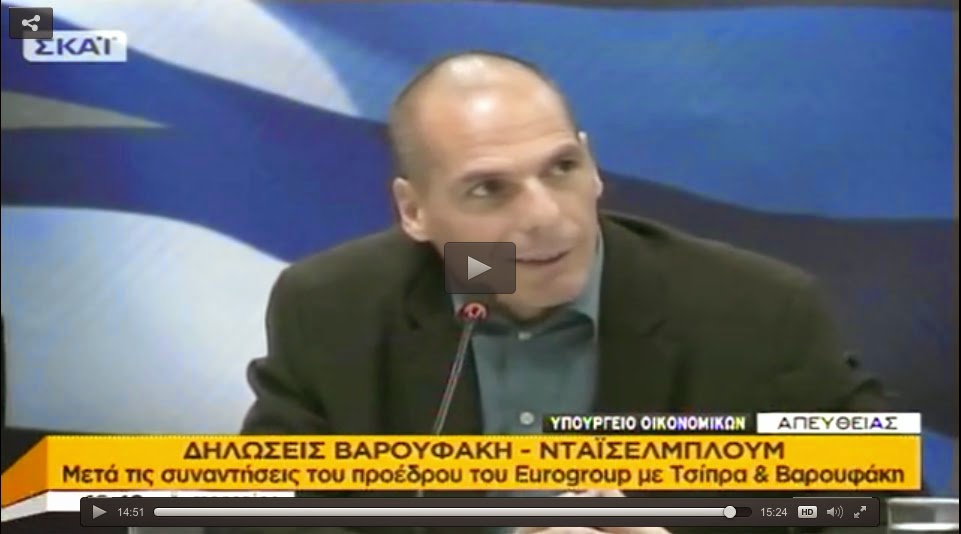
News on Friday was dominated by the press conference held by Yanis Varoufakis, Greek Minister of Finance, and Jeroen Dijsselbloem, head of the Eurogroup (and Dutch Finance Minister).

There are two elements about this press conference which need to be assessed. The first is the purely theatrical aspect designed for the audience of SYRIZA’s political supporters. This occurred at the end of the press conference, after kind words of “constructive meetings” and “mutually beneficial relationships” had been uttered.

Yanis Varoufakis made a statement to the following effect:

We will cooperate with the International Monetary Fund, the European Central Bank, and our Eurozone partners. However, we will not cooperate with the Troika, which, according to the European Parliament, we consider a “rottenly constructed committee”.

(You can see his statement here, in Greek, at starting at 14:00).

There are two things obviously wrong with this statement. The first is that since SYRIZA has no problem with the IMF, ECB and Eurozone creditors on a bilateral basis, complaining about the Troika is illogical. They are exactly the same organisation; the staff of the monitoring missions are employees of the creditors. You can’t accept the legitimacy of the parent organisations (IMF, ECB, EC) but challenge the legitimacy of the monitoring team.

In fact, what SYRIZA is complaining about is its disagreement with a monitoring mechanism for the loan agreement. And this is equally a non-starter. No European or multilateral creditor will lend money to Greece without conditions.

The second is that the insulting nature of the statement and the body language was obvious to anyone watching the press conference. Look beyond the obvious fact that Varoufakis is insulting Dijsselbloem, who acts as the Eurozone creditors’ head of the Troika.

Look at the following stills from the press conference (taken from the Kathimerini media gallery):

Still 1: Varoufakis in his final statement

In this photo, Varoufakis is still playing by the normal script of a press conference, but is delivering his “rotten committee” statement.

Still 2: Varoufakis laughing


In this photo, Varoufakis is chuckling as the simultaneous translaction catches up and Dijsselbloem realises what has been said.

Still 3: Shaking Hands

In this still, Varoufakis and Dijsselbloem shake hands. The Greek finance minister is dressed in a casual manner which is inappropriate for this process. Dijsselbloem leaves without statements.

The political theatre here is obvious: Varoufakis against the Troika. But beyond the theatrics, let's look at the second element of this event: the substance of Varoufakis' declaration. 

1.     Greece will not request an extension of the current programme, and will only negotiate on the basis of a new programme it will define.

2.     Greece will not accept any form of loan conditionality which would be monitored by a monitoring mission from its official creditors. (If you disagree with one Troika, you will disagree with another).

3.    Despite his sophistry about “the European Parliament” defining the Troika as a rottenly constructed committee, Varoufakis has deliberately and gratuitously insulted Greece’s Eurozone partners.

If we take these facts at their face value, then the conclusions are clear: there will be no additional funds disbursed for Greece. It will have to default on its debt by February, and will find it impossible to pay for regular government operations, let alone SYRIZA’s campaign promises.

The damage done by this press conference is clear:

·        While mainstream press were praising Greece’s “valiant stand against austerity” (fundamentally misunderstanding the key issues in Greece) at the beginning of the week, by Friday night opinion had started to harden against Greece and SYRIZA, and will continue to do so all next week.

·        Nearly all Eurozone partners, together with the IMF and ECB, have warned that while debt maturities can be extended, there is no question of a debt write-down. Ireland, Portugal, Spain, France, Germany, Netherlands and Finland have come out against a write-down, as well as against a European debt conference. Wolfgang Schauble stated very coherently that “We’re prepared for any discussions at any time but the basis can’t be changed. Beyond that, it is hard to blackmail us.”

·        Yanis Varoufakis himself left Saturday afternoon for Paris for emergency talks with the French government, trying to put out the fires his statements had caused. He was originally scheduled to leave next week. 

SYRIZA does not seem to understand some fundamental points about the operations of sovereign states or financial partners:

a.      Insulting your official creditors, who have lent you € 252 billion of public funds to correct your own mistakes, is not a good idea. It is certainly not a good idea when you are about to ask them for additional loans and a write-down.

b.      SYRIZA has never explained how it will pay for its campaign promises, let alone manage the Greek economy. At least not in any realistic terms. And aside from a barrage of ad-hoc policy measures announced this week, they have still not announced their policy plan in Parliament. (It is expected this weekend or Monday).

c.      You can’t manage relations between financial sector partners with the clever sophistries and empty platitudes with which you teach an undergraduate seminar on Marxist economics.

d.      It is pathetic that after 2.5 years waiting for the day they would take power since the May-June 2012 double election, SYRIZA is not better prepared, with a real, means-tested plan for implementing their policies and managing Greek debt.

As a result of this press conference, expect to see a major hardening of the European response over the next few days. Minister Varoufakis will no doubt claimed he was “misquoted”, and he has already back-pedalled or claimed he was misquoted several times over the last few days. But no serious creditor believes that Greece will present a “mutually beneficial solution”, and they are tired of Marxist double-speak and empty rhetoric.

Also as a result of this press conference, and the events of this past week:

·       Expect bank deposit withdrawals to accelerate. We should have a complete estimate for January 2015 soon, but preliminary reports have mentioned withdrawals as high as € 20 billion (Lorenzo bini Smaghi in the Financial Times).

·       Greek banks now need to increase their Emergency Liquidity Assistance (ELA) support from the Greek Central Bank. Given the confusion over SYRIZA’s real intention, expect the European Central Bank to restrict further ELA, unless Mario Draghi is feeling unusually generous. I would not be. Greek banks are now technically insolvent, largely due to the actions of their own government.

·       Foreign and domestic investors are already taking flight. The Athens Stock exchange plummeted. Several major projects were either cancelled by SYRIZA or put on hold by the investors.

Alexis Tsipras and Yanis Varoufakis came to power with 36% of the national vote, in an election with a 36% absention rate. That is to say, they have won 2,246,064 votes, which is only 27% of all votes cast, and only 20.8% of the Greek population. One would have hoped that they would govern with humility and carefully-considered actions given the magnitude of the crisis and the fragility of their own support. One would hope in vain.


© Philip Ammerman, 2015

Friday, 23 January 2015

The Day After: Likely Developments Following a SYRIZA Election


Elections in Greece are scheduled for January 25th 2015. This article outlines a baseline scenario for the consequences of a SYRIZA election and its political and economic aftermath. Assuming SYRIZA abides by its electoral promises and no Troika compromise occurs, we forecast a hard default by May 2015.

SYRIZA Electoral Promises
SYRIZA’s core electoral promises were proclaimed at Alexi Tsipras’ speech at the Thessaloniki International Trade Fair. An English language summary can be found on SYRIZA’s website here.
Several electoral promises are the main drivers of the economic scenario. We distribute these between multilateral promises (those dependent on foreign creditors) and unilateral promises (those theoretically capable of implementation based on a national parliamentary majority).
Multilateral Promises
  1. An immediate write-down of 50% of Greece’s existing debt, excepting (theoretically) the IMF portion
  2. A moratorium on repayment of the remaining debt, and linking debt repayments to GDP growth
  3. Reclaiming the Nazi occupation forced loan from Germany
Unilateral Promises
  1. Eliminating the ENFIA property tax and replacing it with a tax on large property holdings
  2. Raising the minimum wage to € 751 per month
  3. Restoring public sector wages and employment
  4. Social programme and revisions to the tax code with total expenditure or revenue impact over € 10 billion
SYRIZA prices the cost of its programme at € 11.4 bln and anticipates revenue of € 12 bln. This estimate is faulty, because its public spending increases and revenue cuts are front-loaded, while a large share of revenue increases are back-loaded. This is seen in three main areas:
  1. Tax arrears collection: we do not believe SYRIZA will be able to collect € 3 billion in tax arrears in 2015. In fact, cancelling the ENFIA tax and lack of clarity over the remaining tax code changes will increase tax arrears and reduce revenue.
  2. Combatting tax evasion and smuggling: while these are very worthy goals, it is doubtful whether they can lead to the [unstated] revenue target within 2015.
  3. The “comfort pillow” of € 11 billion from the Hellenic Financial Stabilisation Fund cannot be seized by SYRIZA. HFSF is a private organisation; the “comfort pillow” concerns EFSF bonds that cannot be monetised in the absence of prior EFSF agreement. (See our previous analysis of HFSF here).

SYRIZA Implementation Assessment
Our core scenario see the following likely results of a SYRIZA attempt to implement its electoral promises.
  1. Given the lack of financial reserves, SYRIZA will have to achieve a negotiated solution within approximately 1 month of election, i.e. by March 1st 2015. As already reviewed, Greece does not have the financial reserves to pay for debt redemptions past February 2015. SYRIZA’s estimates that it can negotiate for 6 months are fantasy.
  2. The Eurozone / Troika partners will not accept either a unilateral write-down of 50% of debt. This has been explicitly stated by nearly all decision-makers within the Troika (Germany, Finland, Netherlands, etc).
  3. Debt reprofiling based on GDP-linked bonds is also a fantasy. The key issue is not the debt:GDP ratio, but Greece’s ability to service its debt. A rising GDP does not result in higher tax revenue or a balanced budget, and has not done so in Greece for years due to tax evasion, corruption, nepotism, protection of different interest groups, high public sector spending, etc. This is clearly illustrated by the fact that Greece has run high deficits even during the boom years, and in fact these deficits were a main cause of the current debt crisis.
  4. Germany will neither accept responsibility for the Nazi Occupation-era loan, nor repay it.
As a result, all of SYRIZA’s unilateral promises will result in failure. The negotiations to this point will take between 1-3 months. At this point (or earlier), SYRIZA will either have to perform a 180-degree U-turn on policy, but at this time it will be too late at least for 2015 debt redemption. This is explained further below.
In terms of unilateral promises, a presumed SYRIZA or SYRIZA-coalition government in Parliament will be able to push through different laws, which will front-load the revenue collapse in Greece. Specifically, we forecast minimum revenue losses of a € 6 billion within 6 months of initial SYRIZA law-making, and total revenue losses of at least € 10-12 billion in 2015.

The Issue of Timing
The comments made in the last two paragraphs should illustrate the danger Greece will find itself in by March-April 2015.
  • The failed negotiations with the Troika will take at least 2 months (to end-March). In this time, Greece has to make debt payments in excess of € 5.1 billion, which it does not have, unless it delays other schedule public sector payments (payroll, pensions).
  • SYRIZA will not have the € 7.6 bln final installment of the second bail-out package, nor the € 11 bln HFSF “comfort pillow” it is relying on to service its debt and ongoing government expenditure during the negotiation period, which it has stated will last for 6 months.
  • SYRIZA’s first laws and wider policies will have the effect of tearing a € 6 bln hole in 2015 central government revenue, or over 10% of the annual total, by May 2015. This will be manifest in slowing tax payments; growing tax arrears; etc.
  • The bank run will continue. Current deposit outflows in January 2015 are possibly as high as € 7-8 billion. Yesterday’s daily outflow alone was estimated at € 1 billion. The four systemic Greek banks have all requested additional Emergency Liquidity Assistance (ELA) from the Greek Central Bank.
  • No other creditor will step up to bail out Greece. Press reports that China or Russia will finance Greece are a ludicrous fantasy. Besides having their own fiscal problems, Chinese and Russian policy-makers are not stupid. They will not fund a country that has just refused to honour prior sovereign debt commitments to its Eurozone partners.

The Crisis – European Policy Response
Unless SYRIZA does a 180-degree U-turn by February 28th, calls back the Troika inspectors, and applies for a third Memorandum with supplemental funding, Greece will face a hard default of debt redemptions between March and May 2015.
At this point, we anticipate the following European policy response:
  1. The European Central Bank will stop accepting Greek government bonds as collateral from Greek private banks for ECB loans.
  2. The € 15 billion ELA cap by the Greek Central Bank will be maintained: no new ELA will be approved.
  3. No Greek government bonds will be purchased under the ECB’s QEIII.
  4. The final installments of the second bail-out will not be disbursed.
  5. The Troika monitoring team will not return to Athens.
Taken as a whole, these steps will require the Greek government to finance its operations and SYRIZA’s political platform solely using its own financial resources. There will be a dramatic spill-over effect into the private sector, creating a major fall in economic activity, and major cancellations by foreign tour operators for incoming tourism.
Assuming the deadlock drags on, then we can expect the following additional measures:
  1. No new European Union structural or cohesion funds will be released to Greece. Greek national involvement will be frozen pending a resolution of the dispute.
  2. Taking a page from the EU’s response to the Austrian Freedom Party’s inclusion in the Austrian government in 2000, there will be a formal or informal freeze on relations with Greece. This may be expressed within certain EU institutions, or on a bilateral level by certain Eurozone Member States.
It will be interesting to see if Finland exercises its collateral call option on its share of Greek debt.

The Crisis – The SYRIZA Response
The magnitude of such a default and its impact in Greece will be significant. Besides the impact on private sector operations and tourism, it should be clear that labour migration will rise, tax revenue collection will fall, and corporate closures and relocations will increase. This will create an additional revenue hit of € 6-10 bln by September 2015. The Greek banking sector will be technically and practically insolvent. SYRIZA will have to implement one or more of the following responses by May-June 2015:
  1. A daily and monthly limit on cash withdrawals from Greek banks will be effected.
  2. A ban will be in effect for most electronic bank transfers abroad: transfers over a certain limit will be banned; others will be subject to Ministry of Finance or Greek Central Bank approval.
  3. By April or May, the government will no longer be able to honour its cash commitments within Greece. It will stop paying private sector contractors: delays will eventually reach a minimum of 6 months; quite possibly 18 months.
  4. By June or July, the government will have to begin paying public sector salaries and pensions partially in promissory notes or government bonds.
  5. Should the crisis continue, SYRIZA may have to take steps to bail-in bank depositors, probably those with over € 175,000. This will be cast as a populist measure, and there may be an exchange of cash deposits for government bonds.

Leaving the Eurozone
We do not believe that Greece will leave the Eurozone. The scenario described above is for a hard default within the Eurozone. Not only is Eurozone membership irrevocable: there exists no practical, legal mechanism to eject a country once it has been admitted.
Moreover, there are three important points to consider:
  1. Leaving the Eurozone does not eliminate Greek debt. Greece cannot unilaterally convert its Euro debt into “New Drachma Debt”: this is a decision that would have to involve its creditors. Even if a “New Drachma” were to be implemented, the debt would remain linked to the Euro-New Drachma Exchange rate. So for all intents and purposes, devaluation will not work, unless it is a form of devaluation that results in hyperinflation in Greece. There is a very real misperception in the Greek press that Eurozone exit = immediate debt write-off. It does not.
  2. Greece will probably continue to operate in the Eurozone by issuing a parallel currency in the form of government bonds or promissory notes. The only real limitation to Eurozone membership in practical terms is governed by the European Central Bank, and its requirements for private banking operations as well as actual cash and central bank reserves in the country. All of these can be bypassed by promissory notes, which of course would immediate lose most of their value, but might be tradable.
  3. Greece remains part of several free trade agreements, notably the European Union and the World Trade Organisation. It is part of a widely inter-connected global economy. Its borders are porous. This means that black market currency operations, smuggling and other phenomena will only grow as the domestic economic climate worsens. Try as it might, SYRIZA cannot shut down Greece’s borders, screen every cargo truck in transit, or every tourist, who might be bringing in currency or black market goods.

Macro and Fiscal Impacts
Should the hard default scenario occur as we describe it, the likely impacts will be:
  • A GDP decline of at least 10%
  • Central government revenue falls from € 51 bln in 2014 to € 40 bln in 2015
  • Incoming tourism falls by 20-25% visitor arrivals and revenue
  • Greek exports and imports fall by a significant magnitude as credit instruments are no longer available
  • Poverty levels will increase
  • Household and corporate debt will increase; non-performing loans will increase
  • Unemployment increases
  • The banking system becomes insolvent.

Will SYRIZA Adapt?
In recent weeks, SYRIZA’s leader Alexis Tsipras has been making superficially moderate statements. He recently suggested that Greece would not secede from NATO, and that any decisions on debt would be a decision made together with European partners. In a recent opinion piece in the Financial Times, he stated that
A Syriza government will respect Greece’s obligation, as a eurozone member, to maintain a balanced budget, and will commit to quantitative targets.
He did not, however, explain how SYRIZA would honour or service its existing debt.
These moderating statements frequently clash with those of SYRIZA members. Yiannis Varoufakis, for instance, yesterday stated in an interview that SYRIZA would make Wolfgang Scheuble “an offer he can’t refuse”, and that the alternative to debt write-off was “death”.
SYRIZA’s political messages for its domestic audience have continued their triumphalist, maximalist tone. These messages will play a direct role in getting the party, which is actually a coalition of 13 groups and independent politicians. Whether Alexis Tsipras can continue to moderate a party that is so apparently drunk on its own success, and so seemingly ignorant of the real world outside the ivory tower, remains to be seen.
Unless the normal reality of Greek public and private sector operations are suspended, it will not be possible for SYRIZA to implement its Thessaloniki programme and the other maximalist policy goals its leaders are promising to Greek voters. European leaders have indicated that no further debt write-offs are possible. Threfore, it is highly likely that unless SYRIZA drops its pledge to write-down 50% of the debt and urgently finds ways to service the existing debt in conjunction with the Troika, Greece is bound for a hard default within the Eurozone in the next 6 months.

(c) Philip Ammerman, 2015
Comments or requests for information can be addressed to: info[at]navigator-consulting.com
This article was originally posted on Navigator Consulting Group. 

Related Posts: