Wednesday, 16 June 2010

Restructuring of Greek government debt begins

Perhaps unnoticed by the national or international media, the restructuring of the Greek government’s debt has officially begun. Despite all protestations to the contrary, the restructuring effort has started right here in Greece, with the draft debt payment schedule for suppliers in the medical sector.

What is a debt restructuring? It is a situation in which a debtor is unable to pays its creditors the full amount owed, according to the payment terms agreed. In this case, there are several options for restructuring:

a. A new payment schedule is agreed upon;

b. A “haircut” on the debt occurs, in which the debtor pays back only a certain percentage of his debts to his creditors;

c. An agreement is made to reduce interest charges;

d. Other forms of compensation are agreed.

According to today’s Kathimerini, the government owes EUR 7.1 bln to suppliers of pharmaceuticals, equipment and disposables/consumables. Some of this debt dates to 2005.

According to an agreement reached yesterday, the government has proposed the following payment system:

a. Debts of EUR 1.45 bln dating from 2005 and 2006 will be settled in cash;

b. Debts of EUR 1.1 bln dating to 2007 will be settled with an interest-free, 1-year government bond as well as a further cash payment of EUR 100 mln;

c. Debts of EUR 2.2 bln dating to 2008 will be settled with an interest-free, 2-year government bond;

d. Debts of EUR 2.05 bln dating to 2009 will be settled with an interest-free, 3-year government bond.

Of the total amount of EUR 7.1 bln owed, approximately EUR 6 bln will be repaid, given that the bonds carry a “discount” of about 15%. The bonds can be redeemed at participating banks, who will in turn use these bonds for collateral at the European Central Bank.

So, the restructuring has begun, and fittingly, it has begun in Greece, to the detriment of its own companies and citizens (and Greece's international medical suppliers).

Make no mistake: this is definitely a restructuring, all protestations to the contrary. Greece’s creditors receive less than they are owed and receive it at a later nominal date.

And my next question is: when will this process start with Greece’s national and international bank creditors?

Related Posts

Will there be a Real Economic Audit this Week?

The Next Greek Debt Discovery

Tuesday, 15 June 2010

Enjoying Greek Public Television (or not)

I’m increasingly convinced that at least 25% of the “problem” in Greece is the lack of a really good, objective and independent national media. This has always been the case, of course, but I’m not sure this sad situation can or should be allowed to continue given the magnitude of the crisis.

On the “NET” news bulletin today, the final clip just before the athletic bulletin was that of Deputy Minister of Health Fofi Gennimata touring a hospital somewhere, possibly in Boeotia. The clip was footage taken from “Star TV”, one of the more ridiculous Greek channels. The clip was entirely out of synch with anything important going on today: the subject was the functioning of some new piece of equipment.

Does Greek public television, a mammoth public organisation financed by mandatory household taxes, really need to show a “Star TV” clip of the Deputy Health Minister in Boeotia? Why? To assure us that she is actually working? Can’t we be a little more subtle in the political manipulation of the news?

What will PASOK order up next? Reports on Greece’s annual wheat cultivation, proclaiming a record harvest? Or the targets of our next 10-year plan for agricultural tractor production?

A little while later, the ET3 anchor was presenting the hospital – pharmaceutical provider “crisis”. His sentence was to the effect that “patients are being held as hostages (ομηρία) by the pharmaceutical providers.”

Hello? There are companies which are still trying to collect debts which date back to 2007 and before, and who have stopped supplying the public hospitals because they are owed money. Yes, of course there have been lots of scandals regarding the cost of pharmaceuticals and consumables in the public healthcare system. And we know exactly why: so that administrators and doctors would make bribes off the procurement contracts, just as they take bribes (“fakellakia”) to arrange routine medical treatment. Did anyone force the government or the public healthcare system to enter these agreements?

There is a double standard at work:

· When dockworkers close off the ports and prevent tourists from boarding their ships, is this called “ομηρία”?

· When student unionists prevent university staff from leaving or entering their university offices, is this called “ομηρία”?

· When the government delays payments to fire fighters, teachers and social workers on part-time contracts, is this called “ομηρία”?

· When the government unilaterally decides to delay the refund of VAT until September, is this called “ομηρία”?

Of course not. It’s only when the government realises it has to pay, that it’s erstwhile “opponents” become “hostage takers.”

This may sound like a minor issue, given the state of things today. But to me, it shows a sloppy and politicised approach to public broadcasting, which unfortunately reflects the double standards and lassitude of public sector officials today.

It does nothing to contribute to an objective public understanding of critical issues affecting the Greek taxpayer. When adding this to the fact that ERT employs over 3,500 staff, runs at least 8 TV channels, and 5 orchestras, it’s very clear that the public sector reforms are not nearly as comprehensive as they should be. The opposite is true.

Related Posts

Neither PASOK nor ND have a plan to Reform the Public Sector in Greece September 4th, 2009

Moody's Downgrades Greek Debt - Correctly

Moody’s yesterday downgraded Greek government bonds to Ba1. This was met by predictable furor in some Greek media. SBC TV, a financial channel, identified this as a conspiracy yesterday afternoon, suggesting that the reasons this happened was so that the European Union did not develop its own ratings agency. Sofokleous 10, a financial blog, termed this a “terrorist act”.

The Ministry of Finance issued a press release, which I quote and translate from Kathimerini:

Today's downgrade of the Greek economy from the Moody's agency in no way reflects either the progress made in the last few months, nor the prospects created by the public fiscal adjustment and improvement in national competitiveness.

The budget execution figures show with great clarity that the programme which Greece has agreed with the European Union, the European Central Bank and the International Monetary Fund is being implemented normally, with the deficit having fallen by 40% compared to 2009. This important improvement has been recognised by the European Commission, the European Central Bank and the International Monetary Fund. In addition, the recession in the first quarter was smaller than that foreseen for the whole year in the Memorandum. VAT revenues collected in the first quarter were higher by 6%, whereas last year they had fallen by 11%.

All structural adjustment activities foreseen by the Memorandum of Understanding are being implemented regularly and many are already ahead of their established deadline. The progress of the debt, although currently rising, is expected to peak in 2013 or perhaps sooner, depending on the creating of more favourable conditions.

The Hellenic Government remains entirely committed to the adjustment of its public debt and the improvement of the development potential of the country.

From the viewpoint of any potential investor, the Greek reform programme is fraught with risk. The good efforts of the Ministry of Finance notwithstanding, the government has been taking serious measures only in the last 3-4 months, and as I recounted in yesterday’s post, there are still very many questions left unanswered. Moody’s had already announced a negative outlook in its last rating on 22 April 2010.


All three major ratings agencies have now downgraded Greece’s sovereign debt to junk status. Standard & Poor’s and Fitch had already done this in April; Moody’s followed this week.


Whatever criticism we can raise against these agencies on their previous ratings of Greek government debt, or mortgage-backed securities, or European banking issues, I believe that their current rating on Greece is correct.


There remains a critical lack of quantitative data on the full extent of Greek public debt. Beyond this, it is clear that the EUR 110 bln package will not be sufficient to fund Greece's public sector borrowing needs past 2012. Unless it is renewed, Greece and Europe will be hit by a new sovereign debt crisis.


It remains to be seen whether the reform package will actually work. I believe it will, but that at least 10 years of austerity will be needed, together with a more radical reform. At present, it’s clear that neither the wider public sector nor the political party system has made the radical changes needed for competitiveness.


Good intentions and Parliamentary committees notwithstanding, much has been announced, but little accomplished. It requires a major leap of faith to assume that the very politicians and political parties responsible for Greece’s current predicament will be able to change the system.

I copy the Moody’s press release below.

London, 14 June 2010 — Moody's Investors Service has today downgraded Greece's government bond ratings by four notches to Ba1 from A3, reflecting its view of the country's medium-term credit fundamentals. Today's rating action concludes the review for possible downgrade, which Moody's initiated on 22 April 2010. Moody's has also downgraded Greece's short-term issuer rating to Not-Prime from Prime-1. Greece's country ceilings for bonds and bank deposits are unaffected by the review and remain at Aaa (in line with the Eurozone's rating).


The outlook on all ratings is stable. “The Ba1 rating reflects our analysis of the balance of the strengths and risks associated with the Eurozone/IMF support package. The package effectively eliminates any near-term risk of a liquidity-driven default and encourages the implementation of a credible, feasible, and incentive-compatible set of structural reforms, which have a high likelihood of stabilizing debt service requirements at manageable levels,” says Sarah Carlson, Vice President-Senior Analyst in Moody's Sovereign Risk Group and lead analyst for Greece. “Nevertheless, the macroeconomic and implementation risks associated with the programme are substantial and more consistent with a Ba1 rating.”


Moody's believes that the Eurozone/IMF support package has sheltered the Greek government from the markets while it enacts the very ambitious fiscal austerity measures and structural economic reforms stipulated by the package. These have the potential to restore market confidence, depending on the effectiveness of the government's execution, and place the country on a more stable debt trajectory. The rating agency's base-case scenario envisions Greece implementing the policy changes it needs to stabilise its debt-to-GDP ratio at around 150% by 2013, and reduce its debt burden, defined as the interest payment/revenues ratio, gradually thereafter (expected at 20% in 2014).


Should the economy respond positively to the competitiveness-enhancing structural reforms, debt stabilisation could be achieved earlier. “There is considerable uncertainty surrounding the timing and impact of these measures on the country's economic growth, particularly in a less supportive global economic environment,” says Ms Carlson. “This uncertainty represents a risk that leads Moody's to believe that Greece's creditworthiness is now consistent with a Ba1 rating, a rating which incorporates a greater, albeit, low risk of default.” Moody's outlook on Greece's ratings is stable, reflecting the substantial probability that the rating will not change over the next 12 to 18 months.


The key factors that will influence the rating agency's view will be the performance of the Greek economy, especially that of GDP and tax revenues. Information on these developments will take some time to accumulate and may prove to be either credit positive or negative. For further information, please see Moody's Special Comment “Key Drivers of Greece's Downgrade to Ba1″ available on www.moodys.com. Moody's previous rating action on Greece was implemented on 22 April 2010, when the rating agency downgraded Greece's rating to A3 and placed it under review for further downgrade.

Related Posts

Will there be a Real Economic Audit this Week?

Greek Debt Forecast to 2015

Asking the Right Questions about Greek Debt

Latest Developments in the Greek Debt Forecast

Forecast of Greek Debt to 2015

Monday, 14 June 2010

Will there be a real economic audit this week?

This week, officials from the “Troika” of the European Central Bank, the IMF and the Eurozone are due in Athens to begin an economic audit designed to monitor progress on Greece’s EUR 110 bln bail-out package.

The PASOK government has launched a critical, even historic round of reforms, in agreement with the Troika. If implemented correctly, these reforms will greatly improve the Greek fiscal situation and part of its competitiveness.

They will not, however, be enough in themselves to assure Greece’s longer-term survival and competitiveness. Indeed, unless the EUR 110 bln package is extended in 2012, Greece will again face a difficult lending situation, and will probably have to default without a further debt renewal.

This will be the subject of a future post. What I am most concerned of today is the fact that although the government is moving in the right direction, it is not moving fast enough, and it is clear that it will not meet many of its targets in the agree time frame.

Let’s take the budget progress as an example: according to the 5-month budget estimate published by the Government Accounting Office, the total deficit “fell” from EUR 14.65 bln to EUR 8.97 bln in the first 5 months of 2010 versus 2009 (all figures in EUR mln).

This is undeniable progress. However, both the income and the expenditure lines are “skewed”:

· The government has decided to delay return of VAT to September 2010, unless tactical audits are undertaken. This means that the “Tax Returns” line of “income” is artificially low.

· Several items of “Expenditure” are not reported:

a. The government has put off paying medical sector debt. It is currently locked in negotiations with pharmaceutical and other providers over its proposal to pay recent debts, from 2007 onwards, using Greek government bonds.

b. The government has not counted the retirement cost package of Olympic Airlines, which has a total price tag of EUR 1.3 bln, and which apparently will, despite previous declarations to the contrary, be paid. It is unclear whether this will be booked to the central budget, or towards the insurance funds.

c. The government has not paid a large number of state employees on temporary contracts, such as teachers, medical assistants, social workers and firefighters, for several months.

d. A large range of government ministries have delayed payment to private sector organizations for services provided. Perhaps the most famous example of this is the Hellenic Tourism Organisation (EOT) / Ministry of Tourism, which is rumoured to owe several hundreds of millions of Euro in debt for previous years’ tourism promotion campaigns.

This budget is therefore open to serious questions. What we see here is probably the “massaging” of data to fit into the terms of the Stability and Growth Agreement. Yet this creativity will unfortunately not make the debt go away. Greece needs more time to consolidate its public sector accounts, and it would be better to be fully honest with its European partners and with the Greek people.

Unfortunately, such full honestly would result in yet another firestorm on European sovereign debt markets. So I can understand if, by the end of this week, the Troika announces itself satisfied with the progress of the SGA and releases the EUR 9 bln tranche.

This causes new questions to arise:

· Moral Hazard: Will the Troika become a willing accomplice in concealing the true measure of Greek debt?

· Medium-term Impact: What will happen in 2012-2013, when the EUR 110 bln package expires, and Greece needs to turn to the markets to refinance at least EUR 60 bln in sovereign debt?

The changes that Greece is making are necessary and long overdue. Some of these, such as the first national inventory to formally record how many people actually work in the Greek public sector, indicate the pathetic state of the latter.

The Troika should insist on close monitoring, but perhaps increase the amount of lower-cost funding as a form of incentive payment for meeting budget conditions.

Otherwise, we are all deluding ourselves. Let’s not forget that of Greece’s EUR 310 bln debt, the maturity was approximately 8 years in total last year. Given the economic crisis that began in 2010, each year will bring a lower maturity at a higher interest rate. Assuming the total debt reaches a minimum 5% rate, Greece’s annual interest rate costs alone rise to EUR 15 bln, which will far outweigh the total savings imposed by the SGA in the next three years.

Related Posts

Greek Debt Forecast to 2015

Asking the Right Questions about Greek Debt

Latest Developments in the Greek Debt Forecast

Forecast of Greek Debt to 2015

Wednesday, 2 June 2010

A thank you to Minister George Papaconstantinou


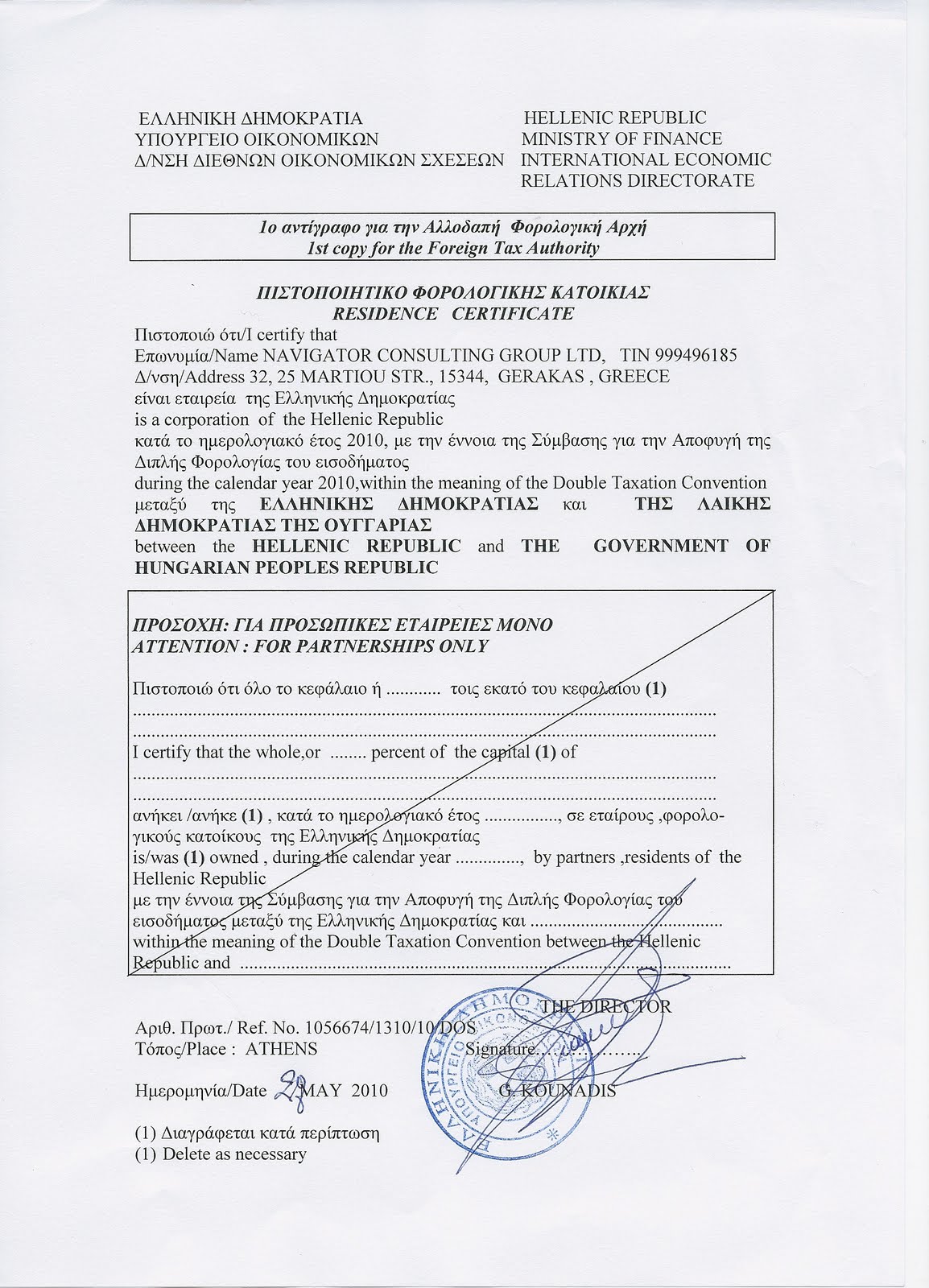
I owe a debt of thanks to the staff of the Ministry of Finance, who assisted in the issue of our corporate tax residency certificate, which was finally issued on Friday, 28 May and was available on Monday, 31 May.

On Tuesday, May 25th, I wrote an email to Minister of Finance George Papaconstantinou, explaining the situation. On Thursday, May 27th, I received a telephone call from the Ministry, asking for clarifications, and promising to clear up the matter. This was duly accomplished.

On Friday, May 28th, I received a telephone call from the Ministry that the tax certificate was ready, and that I could pick it up on Monday, May 31st.

This entire process started on March 17th, and was completed on May 31st. More than anything else, it has challenged my fundamental belief in Greece and its system of economic administration. I have rarely seen so much inefficiency, so many useless processes, and so much public sector hostility for what should be a routine form.

As you can see from one of the certificates (pictured above), the text is entirely simple and indeed innocuous:

I certify that Navigator Consulting Group Ltd, TIN 999496185, registered at 32, 25 March Street, Geraka 15344 Greece, is a corporation of the Hellenic Republic during the calendar year 2010, within the meaning of the double tax convention between the Hellenic Republic and the government of the Hungarian Peoples' Republic."

The Ministry, and its political leadership, are trying to implement an extremely difficult programme, and it’s clear that one of the main barriers is the creaking, inefficient structure of the public administration and its internal processes.

The new government has recently launched some new measures for e-government, pertaining to the payment of automotive circulation taxes and similar measures. I sincerely hope they will be able to stabilise the financial situation of Greece, and implement e-government (especially if they put this tax residency certificate online). Indeed, success is the only option available.

So, to Minister Papaconstantinou and the staff at the Ministry: Thank you for responding to my email, and looking into the matter. And good luck.


Tuesday, 1 June 2010

Greece’s Corruption Non-Scandal

I don’t know if it’s a political tactic, or renewed zeal on the part of Greece’s unelected and unaccountable journalists, but the past month has seen a steady escalation of discoveries of government corruption and dramatic tales of inefficient practice.

·        On Sunday, Kathimerini broke the story that former Defence Minister Akis Tsochatzopoulos’ wife purchased a house on Dionissiou Areopagitou Street for EUR 1.1 mln from a series of two offshore companies, one of which was implicated in the Vatopedi land exchange scandal. The actual value of the house is obviously far higher.

·        Last week, former transport minister Tasos Mantelis admitted to the Parliamentary committee investigating the Siemens bribery scandal that he received DM 200,000 in “pre-election campaigns” from Siemens. This cast the political class into an uproar.

·        Last night, Ioannis Pretenteris reported that the Olympic Village, an organisation set up to manage the 2004 Olympic Games athlete’s village, increased its staff to over 150 full-time staff in the past 4 years, well after the games had ended and most or all of the buildings had been sold or transferred. Among the professions hired included graphic designers, communications experts and psychologists (useful for elections, but not for managing a real estate company without assets). The total wage bill amounted to about EUR 23 million.

·        Makis Triantafyllopoulos reported that based on a comparative analysis of medicine costs, the Hellenic national insurance fund (IKA) is paying significantly more for the same medical disposables (e.g. cotton gauze) than equivalent national health organizations in Italy, France or the UK. In some cases, the difference is over 200-300%.

Although I am very much in favour of public disclosure, I have concluded that none of this steady drip-drip-drip of “scandals” is going to result in a lasting solution. Why?

a.      The only reason that Siemens is an issue is because the German prosecutor’s office has done the investigative work. Greece has taken practically no steps to launch a fully independent, forensic investigation of public procurement and political finance, and does not have such an organisation capable of doing so.

b.     The published amounts of Siemens—loosely stated at about EUR 100 mln in bribes disbursed over a 17 year period—are nearly the same amount as the bribes distributed by the Howaldtswerke-Deutsche Werft (HDW) and its subsequent owners for the construction of four submarines at Skaramangas. This case has also been published by the German prosecutor’s office, but is not being investigated by anyone in Greece. Why the difference?

c.      Siemens is one of two main organisations which provided telecommunications equipment to OTE and other government organisations over the past 20 years. There is another company, Intracom which in the past has featured prominently in corruption allegations. The owner of Intracom, Socrates Kokkalis, is also owner of Intralot, which has gained major contracts with the OPAP betting organisation. Is Intracom the subject of a Parliamentary inquiry?

d.     The amounts procured by the government for weapons contracts and other major capital works (e.g. Athens International Airport, the Attiki Odos, etc.) amount of at least EUR 5-7 bln per year. If we assume a similar system of kickbacks and commissions as what has been already reported in the press, then it’s clear that a DM 200,000 “campaign contribution” from Siemens is an insignificant amount. What is being done to investigate actual contracts, as opposed to individual companies or individual politicians?

e.      One of the main “havens” of dirty money is Cyprus, where there are at least 3,000 offshore companies registered by Greek interests. Many of these companies are shielded behind nominee shareholders, making the identity of the true owners difficult to reveal. What steps are being taken to investigate the ownership of bank accounts in Cyprus, especially given that Laiki-Marfin and Bank of Cyprus have such a large banking network in Greece?

For various reasons, I believe that what we are seeing today is nothing more than a “bread and circus” approach to political corruption. Unless a serious effort is undertaken to use forensic accounting methods, there will be little opportunity to uncover the truth, or recover the stolen money.

Greece has a number of options for this:

1.     It can nominate an independent forensic auditor, such as Debevois and Plimpton, which handled the Siemens investigation, to open a full-scale, independent inquiry. (It’s clear that neither the Hellenic Parliament, nor the PASOK Ethics Committee, to which Mr. Tsochatzopoulos was referred this week, have the capacity to undertake such an investigation, even if they had the political will).

2.     It can require Marfin-Laiki, Bank of Cyprus and other Cypriot banks to provide a list of Greek owners of offshore banking accounts in Cyprus, or face a suspension of their banking licenses in Greece. (This is the same tactic that the US Government has taken in Switzerland with success. However, since so many Greek politicians and their family members appear to have offshore bank accounts, this will probably never happen).

3.     It can appoint a third-party purchasing organisation, such as Crown Agents or SGS, to take over and maintain a transparent, central purchasing organisation for medical equipment and disposables as well as other sectors.

4.     It can request that the US Federal Bureau of Investigation or the US Secret Service set up an independent financial crimes investigative unit, staffed by a Greek expatriate or other newcomer to the Greek scene, for a minimum period of 10 years, with a ring-fenced, full budget and full authority to investigate political corruption.

5.     It can lift the outmoded and corrupting system of Parliamentary immunity and the statute of limitations on certain categories of crimes.

6.     It can demand that the Republic of Cyprus end the practice of nominee shareholding, at least for Greek citizens, or companies receiving funds from Greece.

Obviously, none of this is going to happen. We will be fed a steady stream of serious or not-so-serious disclosures, and perhaps some people will be imprisoned for minor misdemeanors.

It is exceptionally difficult to understand how these serious crimes will be investigated, since their very instigators are often still in Parliament, or represented in Parliament by their descendents and relatives. Alternatively, they are still in the civil service, and in many cases their entire family works there. Alternatively, they are still political party members in good standing.

In the present case, despite whatever good intentions there are (and I welcome them), I don’t believe the same political architects which created this corrupt system have the wherewithal to reform it. Everything we are seeing to date is an effort at damage control, using the full array of meaningless slogans or false outrage such as “μην μας απαξιώνεται” or “μην μας ισοπεδώνεται”.

Christos Papoutsis’ outburst on “Anatropes” last night is an excellent case of this: every other politician I’ve seen on Kardavellas or Triantafyllopoulos or the news in the past 8 days has reacted exactly the same way. Condemn the general situation; deny any personal responsibility; refuse to offer any real solutions or straight answers.

Welcome to the desert of the real.