All last week, I had a powerful sense of living in some form of parallel universe. The dislocation began sharply on Sunday evening, when the election results in Greece rolled in: PASOK won by a landslide. In this universe, it did not matter that PASOK has no economic platform to speak of: it was elected by a margin of 10.5%.
It did not matter that in the week before the election, PASOK shadow Minister of Economy Louka Katselli made repeated references to the state re-nationalising “strategic enterprises”, such as Olympic Airways or the Hellenic Telecommunications Organisation, or the ports of Athens and Thessaloniki.
In this parallel reality, it was not impossible that a bankrupt government would conjure money for this like candy-cane. Nor was it a problem to believe that a government role in these organisations was beneficial. The disastrous result of previous government ownership would be miraculously annulled; a new era of Socialist efficiency would flourish.
In this utopia, it was possible to believe that a efficient government was possible, when Socialist dinosaurs like Theodoros Pangalos, perhaps best known for his role in the Ocalan case, or Evangelos Venizelos, who’s capers in the Ministry of Culture are still celebrated, hold key positions.
It was a parallel universe where speaker after speaker representing the defeated New Democracy would claim on television that self-reflection was needed, and ignore what so many voters know: that New Democracy failed to deliver most if not all of its election promises, and leaves a mess behind it.
No, of course it can’t all be blamed on ND. But enough can: two disastrous fires; the Siemens bribery scandal; the Vatopedi scandal; the structured bonds scandal; the Zahopoulos “revelations” on public finance in the Ministry of Culture. Each of these dossiers today is either closed or unresolved, and something tells me PASOK will not be in a hurry to re-open them.
It was a parallel reality where the hapless leader of the Coalition of the Left (SYRIZA) got up and proclaimed victory because “we are in Parliament,” despite having lost nearly ½ his electoral strength. As if the electoral result was not enough, we heard renewed promises of some kind of “real” socialist revolution in the years to come.
And, I’m afraid it was a parallel universe where on Friday morning, the Nobel Committee awarded the Peace Prize to Barack Obama, “for achievements already made.” I was almost sure this was a hoax, but no, it was true. Somehow, his meager diplomatic triumphs—including paying some destitute South Pacific island to resettle Uigher “terrorists” from Guantanamo, or convincing Turkey to drop its veto of Anders Fogh Rasmussen as Secretary General of NATO—were sufficient for the prize. Certainly, there have been no other achievements in the international realm that I can think of.
And here I was thinking that Mother Theresa or Woodrow Wilson had actually achieved something. Not any more, not judging by this standard.
We are asked by politicians across the world to suspend our disbelief, to turn off our historical memory, to cease any form of independent or objective analysis. And instead of this, to slavishly accept election slogans as a substitute for reality. It’s really no surprise to me that our countries or our societies are in such a mess. What is unfortunate is that I see almost no serious signs that we are prepared to do something about it.
It was with great relief that Friday evening arrived, the weekend started, and I resolutely logged off my news accounts and turned off the TV. Forty-eight hours of peace, calm and sanity returned to our little neighbourhood of Geraka. I’m really dreading what this week will bring.

Monday, 12 October 2009


Monday, 5 October 2009
Karamanlis deserved to lose; did Papandreou deserve to win?
A powerful sense of surrealism hit me upon my return to Athens on Monday evening. For those unaware, national elections were held on Sunday: the opposition PASOK party received what amounted to a landslide victory, winning some 44% of the popular vote and a majority of 160 seats in Parliament. The ruling New Democracy (ND) party received some 33.5% of the vote, and 92 seats in Parliament (down from 151 in the previous government).
The results were unequivocal. Yet I watched the evening news in disbelief as successive ND worthies gave variants of the standard line: “We need to investigate the reasons of our failure.” “We need to engage in a dialogue as to what went wrong.” But aren’t these reasons obvious?
The past 5.5 years of the two Karamanlis administrations have been a litany of failure and lost opportunities. Kostas Karamanlis was elected with overwhelming support, precisely to implement the same electoral promises he has made in the most recent election:
• Reform and streamline public administration
• Reduce the public debt
• Eliminate corruption
• Improve public services, particularly in education, healthcare and public security.
Instead of using this mandate, it’s been business as usual:
a. A succession of corrupt practices, ranging from the improper re-selling of a structured bond to the Zahopoulos fiasco to the Vatopedi scandal to the Siemens corruption probe was essentially allowed to go unpunished. The public simply does not believe that “all cases have been sent to justice”, when it was obvious that not a single person has faced criminal prosecution, and the statute of limitations on crimes by politicians has been repeatedly used to provide immunity to key parliamentarians. No justice has been served. To this day, we still do not know who was responsible for the Vatopedi scandal, how much property was illegally “transferred” and what the government got back when it “froze” the deal.
b. Government debt rose from EUR 195.3 bln in 2005 to 237.2 bln in 2008, according to Eurostat. Taking into account government borrowing which has already occurred in 2009, debt is forecast to rise to between 108-110% of GDP by the end of this year: over EUR 260 billion.
c. In addition to heavy borrowing, there are high unfunded liabilities in pension funds, healthcare and salaries of temporary staff. IKA and OAEE (the two main insurance funds) stated that they needed at additional EUR 553 million to cover obligations in November – December. Hospitals owe over EUR 4 billion to suppliers (some estimates are as high as 6-7 billion). Some temporary staff in the public sector report that their salaries are 3-4 months in arrears. All this indicates that despite the high on-record borrowing, there are still large amounts of operational budget arrears which are not funded.
d. There has been no discernable fall in either public administration headcount, or rise in public administration efficiency. Some strong steps have been taken, such as budget consolidation, limited online interaction, privatisation of Olympic Airways, etc. But few core structural reforms have been made.
e. The Greek state educational system is irrational and uncompetitive against most of its OECD peers. The continuation of Article 16 and the issue of university asylum remain deadlocked. Greece is in violation of the spirit and letter of EU law on academic and vocational education, and shows no signs of addressing this in a coherent, systematic way. The fact that private higher education is unrecognised in Greece by the government is incomprehensible. The fact that primary and secondary education has among the shorted school hours and the most theoretical, centralised standards for curricula and teaching may have been acceptable in 1929, but is no longer acceptable today.
f. Public security has not improved. Complicated the situation is the influx of hundreds of thousands of undocumented immigrants who live in an illegal limbo, with no recourse to law and no means of support.
Karamanlis was elected in March 2004 to solve these problems. One of his memorable campaign lines at this time was “Η Ελλάδα εχει γίνει ξέφραγο αμπέλι” (“Greece has become a fenceless vineyard”). What has changed since then? Not much. Yes, there have been positive changes, but these are mainly at the periphery of public administration and national competitiveness. As a whole, his leadership has been a disappointment. He has never demonstrated a control over his own party, let alone the functioning of the government. Without this basic pre-requisite, it is impossible to take control of the issues and work systematically towards their solution.
For me, at least, it’s clear that Kostas Karamanlis justly deserved to lose this election. It is not at all clear to me, in contrast, that George Papandreou deserved to win it. His party, like Karamanlis’, suffers from the presence of party “barons”, many of whom have a long and painful history of blunders, errors and corruption. His political promises were nebulous, and often relied more on stringing positive adjectives behind a noun than offering any meaningful number or innovative policies.
Several leading PASOK members (and soon to be ministers) are Socialist academics with no real private-sector work experience, and a worrying willingness to re-insert the state in sectors “of strategic interest”, such as Olympic Airways or Hellenic Telecom. This ignores the disastrous consequences of government management of these companies in the past.
Yet Papandreou’s greatest problem is a lack of credibility. I don’t see how you can leave your walled villa, get into a chauffer-driven Lexus 4x4 each morning, and be driven downtown to practice Socialism. I don’t see how being leader of the Socialist International qualifies you to solve the problems of Greece’s public administration, since many of these problems date back to previous Socialist administrations. And I don’t see how the issue of corruption or the public debt or healthcare or education or any of the other pressing problems will actually be solved.
In my opinion, we’ve changed one outmoded political party for another. There do not appear to be any serious plans for meeting Greece’s obligations either under the Lisbon Agenda or the Stability and Growth Pact. Instead, it’s nice words, incremental promises to special interests, but no willingness to take the cross-party, clean-slate, cost-benefit approach which is critically needed to solve Greece’s problems.
My feeling continues to be that unless a totally new political party, indeed a post-ideological political movement is created, we will be arguing exactly the same questions four years from now.
The results were unequivocal. Yet I watched the evening news in disbelief as successive ND worthies gave variants of the standard line: “We need to investigate the reasons of our failure.” “We need to engage in a dialogue as to what went wrong.” But aren’t these reasons obvious?
The past 5.5 years of the two Karamanlis administrations have been a litany of failure and lost opportunities. Kostas Karamanlis was elected with overwhelming support, precisely to implement the same electoral promises he has made in the most recent election:
• Reform and streamline public administration
• Reduce the public debt
• Eliminate corruption
• Improve public services, particularly in education, healthcare and public security.
Instead of using this mandate, it’s been business as usual:
a. A succession of corrupt practices, ranging from the improper re-selling of a structured bond to the Zahopoulos fiasco to the Vatopedi scandal to the Siemens corruption probe was essentially allowed to go unpunished. The public simply does not believe that “all cases have been sent to justice”, when it was obvious that not a single person has faced criminal prosecution, and the statute of limitations on crimes by politicians has been repeatedly used to provide immunity to key parliamentarians. No justice has been served. To this day, we still do not know who was responsible for the Vatopedi scandal, how much property was illegally “transferred” and what the government got back when it “froze” the deal.
b. Government debt rose from EUR 195.3 bln in 2005 to 237.2 bln in 2008, according to Eurostat. Taking into account government borrowing which has already occurred in 2009, debt is forecast to rise to between 108-110% of GDP by the end of this year: over EUR 260 billion.
c. In addition to heavy borrowing, there are high unfunded liabilities in pension funds, healthcare and salaries of temporary staff. IKA and OAEE (the two main insurance funds) stated that they needed at additional EUR 553 million to cover obligations in November – December. Hospitals owe over EUR 4 billion to suppliers (some estimates are as high as 6-7 billion). Some temporary staff in the public sector report that their salaries are 3-4 months in arrears. All this indicates that despite the high on-record borrowing, there are still large amounts of operational budget arrears which are not funded.
d. There has been no discernable fall in either public administration headcount, or rise in public administration efficiency. Some strong steps have been taken, such as budget consolidation, limited online interaction, privatisation of Olympic Airways, etc. But few core structural reforms have been made.
e. The Greek state educational system is irrational and uncompetitive against most of its OECD peers. The continuation of Article 16 and the issue of university asylum remain deadlocked. Greece is in violation of the spirit and letter of EU law on academic and vocational education, and shows no signs of addressing this in a coherent, systematic way. The fact that private higher education is unrecognised in Greece by the government is incomprehensible. The fact that primary and secondary education has among the shorted school hours and the most theoretical, centralised standards for curricula and teaching may have been acceptable in 1929, but is no longer acceptable today.
f. Public security has not improved. Complicated the situation is the influx of hundreds of thousands of undocumented immigrants who live in an illegal limbo, with no recourse to law and no means of support.
Karamanlis was elected in March 2004 to solve these problems. One of his memorable campaign lines at this time was “Η Ελλάδα εχει γίνει ξέφραγο αμπέλι” (“Greece has become a fenceless vineyard”). What has changed since then? Not much. Yes, there have been positive changes, but these are mainly at the periphery of public administration and national competitiveness. As a whole, his leadership has been a disappointment. He has never demonstrated a control over his own party, let alone the functioning of the government. Without this basic pre-requisite, it is impossible to take control of the issues and work systematically towards their solution.
For me, at least, it’s clear that Kostas Karamanlis justly deserved to lose this election. It is not at all clear to me, in contrast, that George Papandreou deserved to win it. His party, like Karamanlis’, suffers from the presence of party “barons”, many of whom have a long and painful history of blunders, errors and corruption. His political promises were nebulous, and often relied more on stringing positive adjectives behind a noun than offering any meaningful number or innovative policies.
Several leading PASOK members (and soon to be ministers) are Socialist academics with no real private-sector work experience, and a worrying willingness to re-insert the state in sectors “of strategic interest”, such as Olympic Airways or Hellenic Telecom. This ignores the disastrous consequences of government management of these companies in the past.
Yet Papandreou’s greatest problem is a lack of credibility. I don’t see how you can leave your walled villa, get into a chauffer-driven Lexus 4x4 each morning, and be driven downtown to practice Socialism. I don’t see how being leader of the Socialist International qualifies you to solve the problems of Greece’s public administration, since many of these problems date back to previous Socialist administrations. And I don’t see how the issue of corruption or the public debt or healthcare or education or any of the other pressing problems will actually be solved.
In my opinion, we’ve changed one outmoded political party for another. There do not appear to be any serious plans for meeting Greece’s obligations either under the Lisbon Agenda or the Stability and Growth Pact. Instead, it’s nice words, incremental promises to special interests, but no willingness to take the cross-party, clean-slate, cost-benefit approach which is critically needed to solve Greece’s problems.
My feeling continues to be that unless a totally new political party, indeed a post-ideological political movement is created, we will be arguing exactly the same questions four years from now.
Tuesday, 29 September 2009
Enjoying the Greek Elections
National elections have been called in Greece for October 4th. Although this may sound counter-intuitive, it struck me last night that the Greek electoral process is vastly superior to its American counterpart:
1. In Greece, everyone knows the politicians are lying, including the politicians themselves. Despite their best intentions, they cannot or will not implement about 85% of their campaign promises. This is a huge advantage over the United States, where true believers still hail George W. Bush as a “compassionate conservative”, and where Barack Obama still walks on water.
2. In Greece, it’s a short campaign. Elections were announced in early September in a televised address by the Prime Minister; the election occurs on October 4th. That’s just over 1 month of campaigning, compared with a US process in which primaries take over a year, and the elections usually 3-4 months after that, and then administrations change two months after the election, in January. This means that in a four-year Presidency, the campaign starts some 2 years prior to the election: 50% of the term of the Presidency is spent campaigning.
3. In Greece, it’s a cheap campaign. Free airtime is provided by all channels. Most expenditure is on additional TV advertisements and outdoor advertising. It’s far less than the billions spent on US campaigns.
4. There is broad and real representation in both national politics and the Greek Parliament. The Parliament currently has five parties, representing the far left to the right. In the United States, despite the presence of the odd third-party contender such as Ralph Nader or Ross Perot, the House and Senate have essentially been duopolies since the beginning of the Republic. I think it’s far healthier having a more diverse political representation, rather than giving two decrepit political parties a monopoly of decision-making.
5. In Greece, in addition to hearing from the party leaders, we hear from party MPs who are slated to become ministers in government debate during the campaign. Yesterday morning, for instance, the PASOK and ND candidates for Minister of Economy & Finance, Louka Katseli and Iannos Papantoniou, were slugging it out on ERT’s morning show. This is great stuff: it permits a far greater level of assessment by the public. In the US, in contrast, the election is all about the President: we only find out about Cabinet nominations some 3-4 months later.
6. And, perhaps most strikingly, the Greek electoral process is straightforward and simple. Voters cast paper votes in their registered place of residence, displaying their legal ID cards. There is no possibility of hanging chads; no need for expensive, computerised voting machines that can be hacked; no way to disenfranchise a voter. Every Greek citizen of 18 years or more has a right to vote. The voting and counting process is overseen by the Bar Association and representatives of political parties. Results are announced by 22:00 of the day of the vote. Recounts, legal processes and Brooks Brothers mobs stealing the Florida election are unknown.
It’s also true that Greek politics are noisy, direct and personal. You may think that having six politicians of various stripes screaming intelligibly at each other in the “parathirakia”, or windows on evening news broadcasts is low behaviour. In fact, it’s politics in its purest form. Debates in the Senate of ancient Athens must have been just like this; debates in the early Congresses in the United States must have been quite similar.
I must say I am enjoying the Greek election far more than I enjoyed the interminably cheesy show between Barack Obama, Hillary Clinton and John McCain. This battle of the titans was long on superficiality and stupidity, but short on common sense and ordinary decency, and is unfortunately replicated in the broken-down, corrupt legislative process we see in Washington today. The American tendency to demand that Presidential candidates are immaculately conceived is ludicrous, particularly given the tremendous costs of the US electoral process which assures rich, special interests a seat at any decision-making table.
In Greece, it’s a far more human, far more simple process. The politicians scream a bit more loudly that usual on the evening shows, a few political rallies are held, and then it’s voting day. And at the end of it we will go back to our tavernas and offices and supermarket aisles without deceiving ourselves that too much has changed, or that the new saviour has come.
1. In Greece, everyone knows the politicians are lying, including the politicians themselves. Despite their best intentions, they cannot or will not implement about 85% of their campaign promises. This is a huge advantage over the United States, where true believers still hail George W. Bush as a “compassionate conservative”, and where Barack Obama still walks on water.
2. In Greece, it’s a short campaign. Elections were announced in early September in a televised address by the Prime Minister; the election occurs on October 4th. That’s just over 1 month of campaigning, compared with a US process in which primaries take over a year, and the elections usually 3-4 months after that, and then administrations change two months after the election, in January. This means that in a four-year Presidency, the campaign starts some 2 years prior to the election: 50% of the term of the Presidency is spent campaigning.
3. In Greece, it’s a cheap campaign. Free airtime is provided by all channels. Most expenditure is on additional TV advertisements and outdoor advertising. It’s far less than the billions spent on US campaigns.
4. There is broad and real representation in both national politics and the Greek Parliament. The Parliament currently has five parties, representing the far left to the right. In the United States, despite the presence of the odd third-party contender such as Ralph Nader or Ross Perot, the House and Senate have essentially been duopolies since the beginning of the Republic. I think it’s far healthier having a more diverse political representation, rather than giving two decrepit political parties a monopoly of decision-making.
5. In Greece, in addition to hearing from the party leaders, we hear from party MPs who are slated to become ministers in government debate during the campaign. Yesterday morning, for instance, the PASOK and ND candidates for Minister of Economy & Finance, Louka Katseli and Iannos Papantoniou, were slugging it out on ERT’s morning show. This is great stuff: it permits a far greater level of assessment by the public. In the US, in contrast, the election is all about the President: we only find out about Cabinet nominations some 3-4 months later.
6. And, perhaps most strikingly, the Greek electoral process is straightforward and simple. Voters cast paper votes in their registered place of residence, displaying their legal ID cards. There is no possibility of hanging chads; no need for expensive, computerised voting machines that can be hacked; no way to disenfranchise a voter. Every Greek citizen of 18 years or more has a right to vote. The voting and counting process is overseen by the Bar Association and representatives of political parties. Results are announced by 22:00 of the day of the vote. Recounts, legal processes and Brooks Brothers mobs stealing the Florida election are unknown.
It’s also true that Greek politics are noisy, direct and personal. You may think that having six politicians of various stripes screaming intelligibly at each other in the “parathirakia”, or windows on evening news broadcasts is low behaviour. In fact, it’s politics in its purest form. Debates in the Senate of ancient Athens must have been just like this; debates in the early Congresses in the United States must have been quite similar.
I must say I am enjoying the Greek election far more than I enjoyed the interminably cheesy show between Barack Obama, Hillary Clinton and John McCain. This battle of the titans was long on superficiality and stupidity, but short on common sense and ordinary decency, and is unfortunately replicated in the broken-down, corrupt legislative process we see in Washington today. The American tendency to demand that Presidential candidates are immaculately conceived is ludicrous, particularly given the tremendous costs of the US electoral process which assures rich, special interests a seat at any decision-making table.
In Greece, it’s a far more human, far more simple process. The politicians scream a bit more loudly that usual on the evening shows, a few political rallies are held, and then it’s voting day. And at the end of it we will go back to our tavernas and offices and supermarket aisles without deceiving ourselves that too much has changed, or that the new saviour has come.
Thursday, 24 September 2009
America Exceptionalism (ii)
What is it with Barack Obama? He can give a great speech, but either he or his speechwriter have a streak of willful arrogance that is totally discordant with reality. Consider these lines from his UN speech:
"This is what we have already done, but this is just a beginning. Some of our actions have yielded progress. Some have laid the groundwork for progress in the future. But make no mistake: This cannot solely be America's endeavor.
Those who used to chastise America for acting alone in the world cannot now stand by and wait for America to solve the world's problems alone. We have sought in word and deed a new era of engagement with the world, and now is the time for all of us to take our share of responsibility for a global response to global challenges."
As I asked before in my blog post about Susan Rice’s comments, WHAT is he talking about? What problems has America solved alone?
Global warming? The US refused to ratify Kyoto under Clinton and Bush. Today, it is the largest emitter of CO2 in the world, and has no real plan for long-term environmental efficiency or CO2 abatement.
Terrorism? The US invasion of Iraq has led to hundreds of thousands of dead and trillions of dollars in damage, with no perceivable benefit in stopping terrorism or the proliferation of weapons of mass destruction. In Afghanistan, politicians dither while the troops make endless sacrifices and thousands of people are killed.
The global economy? US banks and investment firms are at the heart of the current economic collapse. After trillions of Federal dollars pumped into the system, the US financial industry now continues to lobby against any kind of meaningful regulation of the sector.
Mr. President, an objective observer of current events would conclude that rather than solving the world's problems, America has played a leading role in creating many of them. Let's keep this in mind when we lecture the world at the United Nations.
"This is what we have already done, but this is just a beginning. Some of our actions have yielded progress. Some have laid the groundwork for progress in the future. But make no mistake: This cannot solely be America's endeavor.
Those who used to chastise America for acting alone in the world cannot now stand by and wait for America to solve the world's problems alone. We have sought in word and deed a new era of engagement with the world, and now is the time for all of us to take our share of responsibility for a global response to global challenges."
As I asked before in my blog post about Susan Rice’s comments, WHAT is he talking about? What problems has America solved alone?
Global warming? The US refused to ratify Kyoto under Clinton and Bush. Today, it is the largest emitter of CO2 in the world, and has no real plan for long-term environmental efficiency or CO2 abatement.
Terrorism? The US invasion of Iraq has led to hundreds of thousands of dead and trillions of dollars in damage, with no perceivable benefit in stopping terrorism or the proliferation of weapons of mass destruction. In Afghanistan, politicians dither while the troops make endless sacrifices and thousands of people are killed.
The global economy? US banks and investment firms are at the heart of the current economic collapse. After trillions of Federal dollars pumped into the system, the US financial industry now continues to lobby against any kind of meaningful regulation of the sector.
Mr. President, an objective observer of current events would conclude that rather than solving the world's problems, America has played a leading role in creating many of them. Let's keep this in mind when we lecture the world at the United Nations.
Thursday, 17 September 2009
I am a tax evader
I hate to announce this news in public, but … I am a tax evader.
I evade paying both VAT and social security taxes when I hire a cleaning lady to clean up my mess one day per week for my house in Athens. She is legal-I tried-but she doesn’t know how the system works and doesn’t have a book of receipts.
I evade paying VAT and real estate taxes by under-declaring the number of usable square meters and actual loan volume in my house in Athens. In fact, the bank that’s given me the loan helps me in this, as does the Hellenic Tax Authority (the Eforia) through its advice. Honestly, I tried to do it, but if I had declared the true number of square meters (developed by the previous owner), the house would probably have to be torn down and re-built.
My complicity in not demanding receipts from the laiki (farmers’ market) seller when I buy my tomatoes, or from the taxi driver when I take a taxi into Athens, makes me an active participant in VAT and income tax avoidance (of the vendors).
I’m a little bit behind in my TEBE payments…actually some months behind. But I never use the service, don’t understand its benefits, and whenever I have a question I don’t get any answers. Nevertheless, I’m going to catch up this week…or next.
On the other hand, I pay my income tax assessments, declare my income, and when VAT needs to be collected from third-party suppliers in Greece, I collect it and pay it.
Which lead me to my ultimate conclusions: the tax system simply doesn’t work. It’s irrational, and creates too many incentives for tax evasion or avoidance.
Let’s take the real estate tax as an example: in Greece, a real estate object is taxed on the basis of (a) the number of usable square meters, and (b) an “objective value” (minimum value) per square meter.
When you go to buy a house, you immediately determine three things:
(a) the previous owner has made changes to the approved building plan, such as by enclosing balconies, but not declared this to either the Town Planning Authority (Poleodomia) or to the Tax Authority (Eforia), and
(b) The actual value is far above the “objective value”, and everyone knows this, but everyone lists the “objective value” anyway, and
(c) Sellers, buyers and banks are all implicated in this cheerful deceit, even to the point of the banks making off-the-books mortgage transfers to sellers on behalf of buyers.
When government-owned banks start setting up secret accounts to cheat the government from tax revenue, you know there’s a problem.
The whole tax system is a classic case of treating a symptom rather than a root cause. The symptom is tax evasion: in order to combat this, the government has passed hundreds of laws and amendments trying to “fine tune” the system. The result is continuing, rampant tax evasion. I doubt any politician in Greece, or any citizen, can boast that he or she is in 100% compliance of the law. Even the ones that want to.
So the question is, why continue this system? What’s the point of spending hundreds of millions of Euro on antiquated compliance systems which create bureaucracy and paperwork, slow down productivity, and result in a culture of petty corruption and tax avoidance?
I suggest we start to think of basic ways to fundamentally reform the system. I’d start with the following:
(a) Eliminate VAT on any transaction where the main input involves labour. Thus, any professional activities which depend on manual, hourly labour, such as cleaning, construction, market vendors, taxi drivers, waiters, cooks, etc. should not be taxed with VAT. This does not cover professions with a high degree of specialization, such as architects, accountants, lawyers, etc., who should pay taxes under the Personal & Corporate Income Tax Bands (see below).
(b) Levy a flat tax of EUR 750-1,000 per year on all manual trades. No other taxes on personal income, earned by own personal work, should be required. However, if a manual worker has income from other sources (e.g. rental of an inherited apartment), this should be taxed under the standard Personal and Corporate Income Tax bands (seen below).
(c) Equalise corporate and personal income taxes using a “2.5%” flat rate, using tax bands as follows:

The highest corporate or personal income tax band ends at 25% of income. At the personal level, this applies to any individual. Eliminate deductions for children or other claims (replace this with direct subsidy from the state if necessary). The personal income tax applies to independent professionals or salaried employees.
(d) Social taxes on employment and earned income (e.g. professional services) should be levied according to a 1% band, starting at 1%, and rising as follows:

(e) Levy real estate construction or sales taxes on a 1% tax band . These taxes apply either to construction of a new property, or sale of a property, but are only levied once. The maximum tax rate is 10%. This same tax applies to commercial or residential projects. There is no VAT on construction activity, although a form of VAT on construction materials will be set. (This rate does not apply to annual municipal taxes on property).
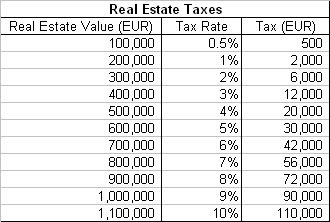
All taxes are based on a professional valuation conducted by a qualified surveyor who is employed by a bank or, in the cases where a bank is not involved in financing, by the tax authority. The valuations of each surveyor will be evaluated separately by a separate branch of the tax authority. Banks cannot provide mortgages unless the buyer or seller provide evidence that the real estate tax has been paid.
(f) Remove complicated taxes for real estate. The only restrictions on real estate in the future will be (a) the building coefficient in terms of total area built, (b) the height of the building and its relationship to the buildings on either side, and (c) energy efficiency, seismic safety, etc. If an owner wants a building with no balconies and 100% internal floor space, it’s up to him. The process of evaluating the “usable” living area and assessing a value on this should be eliminated.
Adopting these bands will create an immediate loss of apparent tax revenue in the short-term, as well as a long-term revenue loss over time. Such a loss must be alleviated in two ways:
(g) Increasing “sin” taxes on alcohol, nightclubs, cigarettes and certain other categories of products and establishments. For instance, cigarette prices are clearly far lower than European norms, and cigarettes are a direct contributor to cancer and adverse health effects. A special health tax on cigarettes of EUR 1 / year should be added until the average price per pack reaches EUR 7.00/pack in 2014. (See table below).
(h) Enforcing the existing tax law on certain categories of establishments and professions, where tax evasion is standard operating procedure. More on this in a future post.
An example of re-calibrating the “sin tax” on tobacco and cigarettes is seen below. In 2009, assuming an average price for a pack of cigarettes of EUR 2, and an average tax rate of 74% of that tax, means that the tax per pack is EUR 1.48, and the total tax which should be attributed to government revenue is EUR 2.48 billion.
Cigarette "Sin" Taxes and Public Revenue

Under my proposal, the price per pack would rise by EUR 1 per year until 2014. The large majority of this price rise would comprise tax. I’ve assumed a 4% increase in the product price; by 2014, a pack of 20 cigarettes would cost EUR 7.00 to buy (which is similar to high street prices in France and Germany today). I estimate that consumption would fall by about 500 million pcs per year. Tax revenue to the government would rise to EUR 9.87 billion. This is nearly 10% of the regular 2008 central government budget.
A "sin" tax of this sort has several collateral benefits: According to the European Commission, Greece has the highest smoking rate in the European Union. Approximately 600 deaths are caused per year from passive smoking; approximately 20,000 per year from active smoking. Reducing the number of smokers would have a positive impact on national public health, while remaining an individual decision as to whether (and how much) someone should smoke.
This tax should be earmarked for shoring up the public health system and pension funds, replacing in part the funds currently collected through high IKA and other payroll taxes. Lowering the payroll taxes should in turn have a positive impact on employment, as people understand that they can keep a higher share of earnings, and employers do not have to count on high payroll taxes in employment.
This proposal does not answer several key questions in Greek tax policy today:
• How to enforce the true recording of income (receipts)?
• Whether the amount earned through indirect taxes will replace the taxes currently payed by a limited number of taxpayers (usually salaries employees)?
• Whether the Greek people will finally respond to positive incentives and assume their legal responsibilities?
• Can these ideas be implemented under EU VAT and tax law?
However, I firmly believe that we need to simplify the tax system and remove as many taxes on labour as we can, particularly for the low-paid, manual trades which are necessary in the Greek economy, and have made Greece a labour magnet since the Soviet Union fell.
Additional posts will be dedicated towards answering some of these questions. But the system needs fundamental renewal, not on-margin tinkering. It is doubtful whether any current political party is prepared to address this issue.
I evade paying both VAT and social security taxes when I hire a cleaning lady to clean up my mess one day per week for my house in Athens. She is legal-I tried-but she doesn’t know how the system works and doesn’t have a book of receipts.
I evade paying VAT and real estate taxes by under-declaring the number of usable square meters and actual loan volume in my house in Athens. In fact, the bank that’s given me the loan helps me in this, as does the Hellenic Tax Authority (the Eforia) through its advice. Honestly, I tried to do it, but if I had declared the true number of square meters (developed by the previous owner), the house would probably have to be torn down and re-built.
My complicity in not demanding receipts from the laiki (farmers’ market) seller when I buy my tomatoes, or from the taxi driver when I take a taxi into Athens, makes me an active participant in VAT and income tax avoidance (of the vendors).
I’m a little bit behind in my TEBE payments…actually some months behind. But I never use the service, don’t understand its benefits, and whenever I have a question I don’t get any answers. Nevertheless, I’m going to catch up this week…or next.
On the other hand, I pay my income tax assessments, declare my income, and when VAT needs to be collected from third-party suppliers in Greece, I collect it and pay it.
Which lead me to my ultimate conclusions: the tax system simply doesn’t work. It’s irrational, and creates too many incentives for tax evasion or avoidance.
Let’s take the real estate tax as an example: in Greece, a real estate object is taxed on the basis of (a) the number of usable square meters, and (b) an “objective value” (minimum value) per square meter.
When you go to buy a house, you immediately determine three things:
(a) the previous owner has made changes to the approved building plan, such as by enclosing balconies, but not declared this to either the Town Planning Authority (Poleodomia) or to the Tax Authority (Eforia), and
(b) The actual value is far above the “objective value”, and everyone knows this, but everyone lists the “objective value” anyway, and
(c) Sellers, buyers and banks are all implicated in this cheerful deceit, even to the point of the banks making off-the-books mortgage transfers to sellers on behalf of buyers.
When government-owned banks start setting up secret accounts to cheat the government from tax revenue, you know there’s a problem.
The whole tax system is a classic case of treating a symptom rather than a root cause. The symptom is tax evasion: in order to combat this, the government has passed hundreds of laws and amendments trying to “fine tune” the system. The result is continuing, rampant tax evasion. I doubt any politician in Greece, or any citizen, can boast that he or she is in 100% compliance of the law. Even the ones that want to.
So the question is, why continue this system? What’s the point of spending hundreds of millions of Euro on antiquated compliance systems which create bureaucracy and paperwork, slow down productivity, and result in a culture of petty corruption and tax avoidance?
I suggest we start to think of basic ways to fundamentally reform the system. I’d start with the following:
(a) Eliminate VAT on any transaction where the main input involves labour. Thus, any professional activities which depend on manual, hourly labour, such as cleaning, construction, market vendors, taxi drivers, waiters, cooks, etc. should not be taxed with VAT. This does not cover professions with a high degree of specialization, such as architects, accountants, lawyers, etc., who should pay taxes under the Personal & Corporate Income Tax Bands (see below).
(b) Levy a flat tax of EUR 750-1,000 per year on all manual trades. No other taxes on personal income, earned by own personal work, should be required. However, if a manual worker has income from other sources (e.g. rental of an inherited apartment), this should be taxed under the standard Personal and Corporate Income Tax bands (seen below).
(c) Equalise corporate and personal income taxes using a “2.5%” flat rate, using tax bands as follows:

The highest corporate or personal income tax band ends at 25% of income. At the personal level, this applies to any individual. Eliminate deductions for children or other claims (replace this with direct subsidy from the state if necessary). The personal income tax applies to independent professionals or salaried employees.
(d) Social taxes on employment and earned income (e.g. professional services) should be levied according to a 1% band, starting at 1%, and rising as follows:

(e) Levy real estate construction or sales taxes on a 1% tax band . These taxes apply either to construction of a new property, or sale of a property, but are only levied once. The maximum tax rate is 10%. This same tax applies to commercial or residential projects. There is no VAT on construction activity, although a form of VAT on construction materials will be set. (This rate does not apply to annual municipal taxes on property).

All taxes are based on a professional valuation conducted by a qualified surveyor who is employed by a bank or, in the cases where a bank is not involved in financing, by the tax authority. The valuations of each surveyor will be evaluated separately by a separate branch of the tax authority. Banks cannot provide mortgages unless the buyer or seller provide evidence that the real estate tax has been paid.
(f) Remove complicated taxes for real estate. The only restrictions on real estate in the future will be (a) the building coefficient in terms of total area built, (b) the height of the building and its relationship to the buildings on either side, and (c) energy efficiency, seismic safety, etc. If an owner wants a building with no balconies and 100% internal floor space, it’s up to him. The process of evaluating the “usable” living area and assessing a value on this should be eliminated.
Adopting these bands will create an immediate loss of apparent tax revenue in the short-term, as well as a long-term revenue loss over time. Such a loss must be alleviated in two ways:
(g) Increasing “sin” taxes on alcohol, nightclubs, cigarettes and certain other categories of products and establishments. For instance, cigarette prices are clearly far lower than European norms, and cigarettes are a direct contributor to cancer and adverse health effects. A special health tax on cigarettes of EUR 1 / year should be added until the average price per pack reaches EUR 7.00/pack in 2014. (See table below).
(h) Enforcing the existing tax law on certain categories of establishments and professions, where tax evasion is standard operating procedure. More on this in a future post.
An example of re-calibrating the “sin tax” on tobacco and cigarettes is seen below. In 2009, assuming an average price for a pack of cigarettes of EUR 2, and an average tax rate of 74% of that tax, means that the tax per pack is EUR 1.48, and the total tax which should be attributed to government revenue is EUR 2.48 billion.
Cigarette "Sin" Taxes and Public Revenue

Under my proposal, the price per pack would rise by EUR 1 per year until 2014. The large majority of this price rise would comprise tax. I’ve assumed a 4% increase in the product price; by 2014, a pack of 20 cigarettes would cost EUR 7.00 to buy (which is similar to high street prices in France and Germany today). I estimate that consumption would fall by about 500 million pcs per year. Tax revenue to the government would rise to EUR 9.87 billion. This is nearly 10% of the regular 2008 central government budget.
A "sin" tax of this sort has several collateral benefits: According to the European Commission, Greece has the highest smoking rate in the European Union. Approximately 600 deaths are caused per year from passive smoking; approximately 20,000 per year from active smoking. Reducing the number of smokers would have a positive impact on national public health, while remaining an individual decision as to whether (and how much) someone should smoke.
This tax should be earmarked for shoring up the public health system and pension funds, replacing in part the funds currently collected through high IKA and other payroll taxes. Lowering the payroll taxes should in turn have a positive impact on employment, as people understand that they can keep a higher share of earnings, and employers do not have to count on high payroll taxes in employment.
This proposal does not answer several key questions in Greek tax policy today:
• How to enforce the true recording of income (receipts)?
• Whether the amount earned through indirect taxes will replace the taxes currently payed by a limited number of taxpayers (usually salaries employees)?
• Whether the Greek people will finally respond to positive incentives and assume their legal responsibilities?
• Can these ideas be implemented under EU VAT and tax law?
However, I firmly believe that we need to simplify the tax system and remove as many taxes on labour as we can, particularly for the low-paid, manual trades which are necessary in the Greek economy, and have made Greece a labour magnet since the Soviet Union fell.
Additional posts will be dedicated towards answering some of these questions. But the system needs fundamental renewal, not on-margin tinkering. It is doubtful whether any current political party is prepared to address this issue.
Monday, 14 September 2009
Neither PASOK nor ND have a plan to reform the public sector in Greece
 ERT Building (c) ERT AE
National elections have been called for October 4th in Greece. For perhaps the first time, both PASOK and ND are vying with each other over who will introduce the most austere budget. This is a welcome change, if it were believable. I believe both party leaders are sincere. But I also believe that the party barons on both sides, as well as decades of vested interest, will sabotage or slow any reform implemented.
What Greece needs is a vision of lean government. Right now, the parties are focussing on top-line, revenue and expenditure assumptions:
• We will freeze public sector salaries
• We will freeze new hiring
• We will crack down on debt avoidance.
Unfortunately, there is no unifying vision or coherence to these measures, or how these would affect the fundamental structure and operations of public administration.
Let us view a simple example. Greece has no fewer than five public broadcast channels. These are bundled under ERT A.E., a public organisation that functions according to private law. ERT A.E. includes the following channels:
• NET
• ERT 1
• ERT 3
• ERT World
• Digital Channels : Prisma, Cine, Spor
• Vouli TV
In addition to this, the government is already funding a range of local authority and municipal TV stations, which mainly transmit programmes of local interest, and occasionally meetings of municipal councils.
The main organisation, ERT, is funded by a mandatory tax on electricity bills. It has some 3,500 employees, and a range of ancillary activities, including several radio stations, a publishing company, and no less than five orchestras:
• National Symphony Orchestra
• Orchestra of Contemporary Music
• ERT Choir
• ERT-3 Orchestra
• Childrens’ Orchestra.
I am a great fan of public TV: in Greece, it is one of the few quasi-objective media organisations (although I am sure this is also open to debate). But frankly, we are in the middle not only of an economic crisis, but of a situation where public debt has reached at least 103% of GDP, and quite possibly 108-110% by the end of 2009. We simply don’t have the resources for massive public sector organisations and repetitive functions which in many cases are paid for by the taxpayer without recourse or choice.
I would expect to see an attempt to transform the Greek public sector using the tools of lean management and e-government. If we take the example of ERT and public media in Greece, I would expect to see the following strategic changes:
1. Greek public TV will comprise 3 channels:
• A national terrestrial broadcaster
• A terrestrial broadcaster oriented towards northern Greece and the Greek islands (ERT 3)
• A digital/satellite broadcaster oriented towards Greeks of the diaspora and equivalent markets
2. All ancillary functions will be divested or closed.
3. All local TV and parliament TV can continue, but will be broadcast only online, and will not be paid for by the central government as a separate item. The costs should be borne by the IT budgets of these organisations, and should be less than EUR 1,000 per organisation from the central budget, with anything remaining gained by sponsorship or advertising.
4. The Greek state will only support a limited number of orchestras, choirs, etc. In any case, the budget for these activities has nothing to do with state television: it should be transferred to the Ministry of Culture. No more than two national symphony orchestras are needed in the entire country: one in Athens; one in Thessaloniki, which are paid for by public funds.
5. The strategic role of the national broadcaster should be to conduct in-depth analyses of Greek history, culture, news, economy, and international relations. We do not need so many programmes on recipes, sports, Greek music, etc. How many separate yet similar programmes on Greek music are aired by ERT, and why are these needed?
6. The headcount of ERT will shrink to 1,250 within 4 years, from the current total of 3,500. The celebrity media culture of untrammelled spending for gossip TV, Eurovision, and other frankly ridiculous events which are currently programmed by ERT must end.
7. Should a public subsidy for ERT continue, it will be collected by the normal tax collection method, and not through DEH (public electricity authority) bills. DEH is a totally separate business, which—apart from convenience—should not function as a billing mechanism for another quasi-governmental organisation. In any case, any public subsidy should be re-channelled to debt reduction, while ERT should improve its already important advertising revenue.
8. All major public debates and decisions should be put online as a matter of course; every Greek (and other) citizen should have access to government through the internet.
Similar decisions are needed in every government or semi-governmental organisation. The time of “caviar socialism” is over: unless hard decisions are made on the basis of a real cost-benefit analysis, the country will soon reach a debt-to-GDP ratio of 140-150%, and it will then be bankrupt.
Greece is spreading its expenditure across thousands of public organisations, replicating a model of government suited to the 1800s of employment and patronage over efficiency. There needs to be a clear strategy of focussing the role of government where it is truly needed, and exiting ancillary functions. Where government is needed, for instance in education, healthcare or the military, then we should spend the correct amount of resources to make sure Greek citizens receive world-class services, not banana republic excuses.
We need to develop a public sector from the ground up, using lean thinking and the power of the internet, if we are to compete, and indeed survive, in the future.
Subscribe to:
Posts (Atom)